


Do you know how to perform CPR ??? WELL YOU GONNA LEARN TODAY !
|
Posted By: DAVID JOHNSON on April 20, 2013
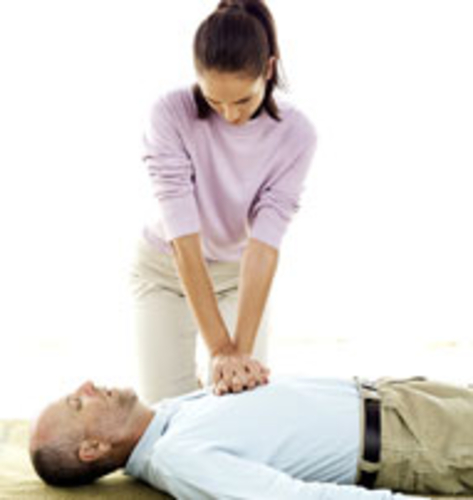
http://www.emergencycareforyou.org/Emergen... Learning how to perform cardio-pulmonary resuscitation (CPR) saves lives. While no statistics are available on the exact number of lives sudden cardiac arrest claims per year, approximately 335,000 people die annually of coronary heart disease without being hospitalized – or about 918 Americans each day, according to the American Heart Association (AHA). Conventional CPR consists of chest compressions and rescue breathing. The American Heart Association continues to support this approach to CPR, but recent research demonstrates that rescue breathing may be unnecessary and potentially detrimental in cases of cardiac arrest. In the interest of presenting complete information, however, ACEP is including instructions on how to provide rescue breaths in this guide for laypersons who choose to employ them. The tips provided below are based on procedures recommended by the AHA and are not a substitute for formal training in CPR. The AHA and the American Red Cross offer CPR courses; to register, contact the AHA at 1-800-AHA-USA1 or your local American Red Cross chapter. Everyone in your family should take one of these courses, and you should have your CPR skills tested at least every two years. Automated External Defibrillators (AEDs) are increasingly available at many locations, such as shopping malls and airports. They are small, lightweight devices used to assess a person’s heart rhythm. An AED can detect the need for and administer an electric shock to restore a normal heart rhythm in people with sudden cardiac arrest. ACEP supports widespread distribution of AEDs, as long as it is coordinated with existing EMS systems and includes proper training. Logical places for AEDs include police cars, theaters, sports arenas, public buildings, business offices and airports. An increasing number of commercial airplanes are now equipped with AEDs and enhanced medical kits. CPR is typically administered in cases of cardiac arrest. Signs of cardiac arrest include an absence of heartbeats, blood flow and pulse. When blood stops flowing to the brain, the person becomes unconscious and stops regular breathing. The ABCs of CPR are Airway, Breathing, and Circulation. This acronym is used to help you remember the steps to take when performing CPR. Airway If a person has collapsed, determine if the person is unconscious. Gently prod the victim and shout, “Are you okay?” If there is no response, shout for help. Call 911 or your local emergency number. If the person is not lying flat on his or her back, roll him or her over, moving the entire body at one time. Open the person’s airway. Lift up the chin gently with one hand while pushing down on the forehead with the other to tilt the head back. (Do not try to open the airway using a jaw thrust for injured victims. Be sure to employ this head tilt-chin lift for all victims, even if the person is injured.) If the person may have suffered a neck injury, in a diving or automobile accident, for example, open the airway using the chin-lift without tilting the head back. If the airway remains blocked, tilt the head slowly and gently until the airway is open. Once the airway is open, check to see if the person is breathing. Take five to 10 seconds (no more than 10 seconds) to verify normal breathing in an unconscious adult, or for the existence or absence of breathing in an infant or child who is not responding. If opening the airway does not cause the person to begin to breathe, it is advised that you begin providing rescue breathing (or, minimally, begin providing chest compressions). Breathing (Rescue Breathing) Pinch the person’s nose shut using your thumb and forefinger. Keep the heel of your hand on the person’s forehead to maintain the head tilt. Your other hand should remain under the person’s chin, lifting up. Inhale normally (not deeply) before giving a rescue breath to a victim. Immediately give two full breaths while maintaining an air-tight seal with your mouth on the person’s mouth. Each breath should be one second in duration and should make the victim’s chest rise. (If the chest does not rise after the first breath is delivered, perform the head tilt-chin lift a second time before administering the second breath.) Avoid giving too many breaths or breaths that are too large or forceful. Circulation (Chest Compressions) After giving two full breaths, immediately begin chest compressions (and cycles of compressions and rescue breaths). Do not take the time to locate the person’s pulse to check for signs of blood circulation. Kneel at the person’s side, near his or her chest. With the middle and forefingers of the hand nearest the legs, locate the notch where the bottom rims of the rib cage meet in the middle of the chest. Place the heel of the hand on the breastbone (sternum) next to the notch, which is located in the center of the chest, between the nipples. Place your other hand on top of the one that is in position. Be sure to keep your fingers up off the chest wall. You may find it easier to do this if you interlock your fingers. Bring your shoulders directly over the person’s sternum. Press downward, keeping your arms straight. Push hard and fast. For an adult, depress the sternum about a third to a half the depth of the chest. Then, relax pressure on the sternum completely. Do not remove your hands from the person’s sternum, but do allow the chest to return to its normal position between compressions. Relaxation and compression should be of equal duration. Avoid interruptions in chest compressions (to prevent stoppage of blood flow). Use 30 chest compressions to every two breaths (or about five cycles of 30:2 compressions and ventilations every two minutes) for all victims (excluding newborns). You must compress at the rate of about 100 times per minute. Continue CPR until advanced life support is available. Using an AED in conjunction with CPR: If using an AED in the case of a heart attack or cardiac arrest, single shocks should be followed by immediate CPR for two minutes. Heart rhythm checks should be performed every two minutes (or after giving about five cycles of CPR); the AED will provide audible prompts at the appropriate intervals. See AED section for details. If using an AED on a one- to eight-year-old child, use a child-dose-reduction system if available. (However, do not use child pads or a child dose on adults in cardiac arrest because the smaller dose may not defibrillate adults properly.) CPR for Infants (Up to One Year Old) Airway With infants, be careful not to tilt the head back too far. An infant’s neck is so pliable that forceful backward tilting might block breathing passages instead of opening them. Breathing Do not pinch the nose of an infant who is not breathing. Cover both the mouth and the nose with your mouth and breathe slowly (one to one and a half seconds per breath), using enough volume and pressure to make the chest rise. With a small child, pinch the nose closed, cover the mouth with your mouth and breathe at the same rate as for an infant. Rescue breathing should be done in conjunction with chest compressions. (See next section.) Chest Compressions on Infants If alone with an unresponsive infant, give five cycles of CPR (compressions and ventilations) for about two minutes before calling 911 or your local emergency number. Use only the tips of the middle and ring fingers of one hand to compress the chest at the sternum (breastbone), just below the nipple line, as described in the table below. The other hand may be slipped under the back to provide a firm support. (However, if you can encircle your hands around the chest of the infant, using the thumbs to compress the chest, this is better than using the two-finger method.) Depress the sternum between a third to a half the depth of the chest at a rate of at least 100 times a minute. Two breaths should be given during a pause after every 30 chest compressions (a 30:2 compression-to-ventilation ratio or two breaths about every two minutes) on all infants (excluding newborns). Continue CPR until emergency medical help arrives. Small Children (ages one to eight) Give five cycles of CPR (compressions and ventilations) for about two minutes before calling 911. Use the heel of one or two hands, as needed, and compress on the breastbone at about the nipple line. Depress the sternum about a third to a half the depth of the chest, depending on the size of the child. The rate should be 100 times per minute. Give two breaths for every 30 chest compressions (30:2 ratio) or two breaths about every two minutes. Continue CPR until emergency medical help arrives. How to Perform CPR (PDF) How to Perform CPR http://www.emergencycareforyou.org/Emergen... If you enjoyed this article, Join HBCU CONNECT today for similar content and opportunities via email! |
 |
DAVID JOHNSON
BROTHER KNOWLEDGE, THE BOOKS Member Since January 2010 |
Comments
More From This Author
Latest Blogs
 |
Personalized medicine: How tailored treatments are transforming healthcarePhoto: Futuristic healthcare scene showing a physician analyzing a patient's genetic data on advanced digital screens, illustrating personalized medicine, precision healthcare, artificial intelligence ...more
Joel Savage • 5 Views • November 7th, 2026 |
 |
The death of privacy: How much of your life exists online?A person standing in a futuristic digital environment surrounded by glowing data streams, social media icons, biometric scans, and privacy lock symbols, illustrating the challenges of protecting perso ...more
Joel Savage • 85 Views • November 6th, 2026 |
 |
2026 Hyundai IONIQ 5 Limited vs. 2025 IONIQ 5 N: EV Performance or Everyday CommutingHyundai has shown that electric vehicles can deliver everything from sports-car performance to luxury, comfort, and impressive driving range. After test-driving the 2025 Hyundai IONIQ 5 N, a high-perf ...more
Randi Payton • 115 Views • November 5th, 2026 |
 |
Global water governance crisis threatens peace and security nowPhoto: Major international rivers flowing across borders with dams and drought-affected regions illustrating global water governance challenges.
Water is essential for life, economic development, ...more
Joel Savage • 87 Views • November 5th, 2026 |
 |
Los Angeles Based Soulful Brothers THE RONEY BOYS Release Smooth New Single "Gas U Up"@THERONEYBOYS #THERONEYBOYS
YouTube@TheRoneyBoys
FB@ThrRoneyBoys
IG@TheRoneyBoys
TikTok@TheRoneyBoys
Video For "Gas U Up" Below..
https://youtube.com/watch?v=pq38jqeiDEI&is=KyaVG5j8rNl5b677
...more
LaMarr Blackmon • 204 Views • November 4th, 2026 |
Popular Blogs
 |
Divorce in America in 2009 – What’s love got to do, got to do with it?
Join Brother Marcus and the cast and the crew of the Brother Marcus Show live this Sunday evening on February 1, 2009 @ 8:00 p.m. for another hot topic in our community! “Divorce in America in 2009 ...more
Brother Marcus! • 75,775,260 Views • January 27th, 2009 |
 |
VISINE ALERT!!!Seemingly innocent medication such as Visine eyedrops are used by people to concoct a mixture with similar effects as a date-rape drug.
When mixed with alcohol and taken orally, the eyedrops can l ...more
Siebra Muhammad • 123,017 Views • May 23rd, 2009 |
 |
"Chain Hang Low" check out the real meaning of the Lyrics!Recently there is a new artist out of Saint Louis that goes by the name JIBBS. Jibbs debut single "Chain hang low" has a history that most people are not aware of. The particular nursery rhyme that th ...more
Tyhesha Judge-Fogle • 82,101 Views • November 9th, 2006 |
 |
HBCU Marketplace Gifts: Divine 9 Premium Fraternity / Sorority Playing CardsVendor: Charles Jones
Item Price: $20.00
Price Includes Shipping: Yes - Shipping Included
Item Description:
Pantheon Series - Divine 9 - Premium Playing Cards (choose Gold Series or Silve ...more
Hija Chang • 65,031 Views • December 2nd, 2018 |
 |
Black College Student Sentenced to 12 Years in Prison for Kissing a White GirlAlbert N. Wilson, a former University of Kansas student, has been sentenced to 12 years in prison and a lifetime of probation after being convicted by an all-white jury of raping a white teen girl. Bu ...more
Roger Gates • 57,718 Views • June 4th, 2020 |


