




Students Taunted for Having Light Skin
|
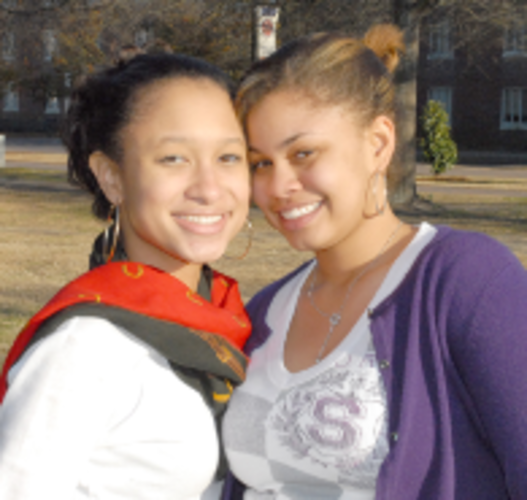
Posted By: Jehan Bunch on February 04, 2009 FEATURED Content By Jernai Ellis, Chassidy Hinton -- Black College Wire The Collegian Chassidy Hinton (left), Jernai Ellis "Light Bright," "White Girl," "High-lighter," "High Yellow," "Red Bone," "Mulatto," "Light-skinned-ed," "See Through," and "Transparent;" these are names one would think were heard 50 or more years ago, or even on a playground. But they are names that we have both been called since we started our matriculation at South Carolina State University. Neither one of us knew the extent to which we would be singled out just for the color of our skin, especially at a historically black university. One would assume that being at an HBCU, students of African-American descent would unite because of a common ancestry. Instead, people seem to look at the smaller things that divide us, rather than the much larger things that unite us. Jernai Ellis: I am from farther north, from the suburbs of Bowie, Maryland, and I have never had to deal with what is being called a "Color Complex." When I first got here, I did not really enjoy being referred to as a "high-lighter" or "light-bright." It was annoying, because there is so much more to people than what they look like. Chassidy Hinton: Coming from Raleigh, N.C., I have had more encounters with this complex, but never to the extent that I have experienced it here at SC State. It definitely agitates me when people, specifically those whom I am not well acquainted with, begin conversations with, "What's up, white girl?" Even though I may have been called these names before, I will never grow accustomed to it. Neither of these nicknames have any positive attributes. I will never acknowledge them as being comical. One could look no further than the history books than to see where the dividing factor between African-Americans of a light complexion and those of a brown or darker complexion began.In an article written by Hazel Trice Edney, in the Louisiana Weekly about prejudice against light skinned persons, the author discusses the source of this divide. "The white slave master showed preference to light-skin slaves, giving them jobs as 'House Negroes' while their dark-skin counterparts labored in the fields. And more often than many people would like to admit, slave owners and their sons would take sexual liberties with defenseless black women, producing near-white off springs that were neither acknowledged nor accepted by the slave owner's family." Julia Hare, a psychologist and executive director of the Black Think Tank, a web resource to discuss black issues in San Francisco, notes that the issue of color is still very prevalent."You would have thought that this thing would have ended after the so-called free movement and slavery supposedly was over," Hare writes. "But black people have taken on the same patterns as the slave master. Wherever you go, I don't care if it's in the church, I don't care if it's in the bar, I don't care if it's in the corporate rooms, I don't care if it's on a cruise, color still comes up among black people." Through our experiences and observations, we find it ironic that light-skinned males seem to not experience as much negativity as light-skinned females. Females are often deemed as "stuck-up" or "snobbish." Unfortunately, going to a school in the South, [we see] this idea permeated much further than either one of us had imagined. It is a common notion that people often judge others as a method to "save" the time that it would take to get to know the individual. When one chooses to judge an individual, specifically in the black community, solely on the basis of skin color, they show that they are unaware of the progress that black society must continue to make. As black Americans, we must strive towards success, instead of continuously looking for means of improperly judging and holding each other back. [Related story: Click here.] Comments on this article (2) Jernai Ellis and Chassidy Hinton are students at South Carolina State University. They wrote this article for The Collegian, the SC State student newspaper, which originally published it. Posted Feb. 03, 2009 If you enjoyed this article, Join HBCU CONNECT today for similar content and opportunities via email! |
 |
Jehan Bunch
From Columbus, OH Central State University class of 2005 Member Since January 2006 |
Comments
|
I agree that it is unfortunate that this continues to be an issue amongst our own people. Growing up in WA State and then going to college in TX, I never realized how much of an issue it is in the South to be dark skinned vs light skinned. A lot of men especially either take issue with one or the other or HIGHLY prefer one over the other. I nearly smacked a dude when he told me I was "cute for a dark girl". WTF is that?? Why cant I just look good REGARDLESS?
Monday, February 16th 2009 at 3:22PM |
|
"Guest Visitor" should have the courtesy to use his/her identity in making comments on this forum. The young ladies have a valid complaint, not saying they won't"do just fine". And the comment about the dark skinned Bro is indicative of a small intellect. Wake up, Yo. If you have the balls to make such a comment, reveal yourself. Or we can forget this. Taunts are out of place for anyone attending a HBCU. That was one of the original purposed for founding those colleges, to protect young people from the taunts and slanted attitudes they would find in the "other"American colleges and universities many years ago. It's too bad that some folks never learn, but it is a truth.
Monday, February 16th 2009 at 3:25PM |
 |
Watching it since I arrived in this country about my girlfriends, in my neighborhood they just happened to be light skinned, and had beautiful hair and were pretty and were smart--but they were blacker than black in their souls!! it was also a time when their mothers didn't tell them you are light skinned so you will have it easier or better. But then the whole neighborhood for the most part was composed of lighter hues. I did note that THEY didn't have an issue with their skin color, so this is an interesting blog.
Tuesday, February 17th 2009 at 1:14PM |
|
Julia Hare,Ph.D just told you the truth--it's not going away..and I agree with cece.
Tuesday, February 17th 2009 at 1:17PM |
 |
Visitor- May i say that this is truly sad and frivolous ...the simple differences in our same race that drives us apart from each other instead of a woven people of the same cultural background. People we all are of the same descent. Why are we the only race that would prefer to taunt and bring down our own people.As a dark complexed young woman myself Itoo have had my share of taunts and ignorant remarks refering to my dark complexed toned .As i have been brought up ,seen through my own eyes ,around my environment(High school) i have seen that light complexed woman are more preferred than young ladies my tone.If dark and chosen their either thick or very curvaceous . I see that some girls have had low self esteem and have taken their anger on the lighter complexed girls.This is sad it causes many of young black woman to be confused and ashamed of who they are due to beauty portrayed by the media and the little fast boys that surround them.So i think that this continuing up to a higher education learning institute especially a HBCU is still disappointing to hear amongst the the younger adults .This shows that we still think the same no different than a 100 years ago. So maybe the darker toned individuals are resentful towards the lighter complexed individuals due to intimidation? I don't know but our younger generation still think this way and it saddens me deeply as a sophomore in high school to hear even younger than my self to hear the same people of the same descendant argue amongst them selves due to their difference in complexion,tone or hue.
Tuesday, February 17th 2009 at 10:40PM |
|
XD the name is Shanice by the way ^
Tuesday, February 17th 2009 at 10:41PM |
 |
Skin color is determined by genesby the momma and the poppa. THAT'S ALL!! It is a crying shame that there are still individuals who have this light skin/dark skin complex. WAKE UP, it is 2009 and some of these folks are still going backwards. Just to show some people how small-minded and idiotic they sound by placing emphasis onskin tone, here is a quick biology lessen: I am a dark brown ski female and my husband is also a dark brown skin male. We have two kids together. My son, Israel, is the same hue as me and my daughter, Isis, actually has a lighter skin tone that all three of us. I found out that my maternal grandmother was a "light-skin" woman and my husband's family has a large amount of "light-hued" tone relatives in his fam. My point is: even though I have a light skin daughter, she is still from me and her father and it is almost like the lottery. Me and her dad both had genes in our DNA that would give our offspring either light skin or dark skin. Our son received the DOMINANT GENESFOR DARK SKIN! Our daughter received the DOMINANT GENES FOR LIGHT SKIN! Also, it makes me wonder because so many people come up to me and tell me, "Your daughter is so pretty". Is it because she truly pretty or is it her light skin features? Just maes me wonder? It is sad to think like that but this madness has been going on for so long, I just don't understand it and never will.
Wednesday, February 18th 2009 at 12:25AM |
 |
I know where these two ladies are coming from. Many people look at us as being "too light" to be black, and even at times think that because we are light-skinned, we must experience less descriminatory acts and racial predjudice by others. That notion is completely and utterly false. White people think of us all in the same manner, no matter shade. If you can't pass for being white, in their eyes you are black or whatever race or ethnicity that's not white. The problem with that is; we have some white people not liking us because we are black and some blacks not liking us because we are light-skinned. I think the blacks who don't like us because of our color, only hate their own color and wish they had our shade. Those who want it can have it. I'm going to have kids with a dark-skinned sistah so my kids won't have to feel like they aren't "black enough" at time, like I have. I love my color and I love my people and im not going to let the ignorant bring me down. BLACKS PEOPLE COMES IN ALL SHADES AND SIZES!!!!
Friday, February 20th 2009 at 5:06PM |
|
Amen to that ^ i don't see why people cant be proud of their complexion heck i love it i just wish that everyone could just accept both i mean really when it all comes down to it when the lights go out were all black. lol XD just trying to lighten the mood .(no but seriously)As i have stated in my previous comments is sad that people have these preconceived preferences and this mind set mentality.Its sad and sickening ,they have a harder time being accepted by both , which is ridiculous we all need to be united people Friday, February 20th 2009 at 10:04PM |
More From This Author
Latest News
 |
From Research Orchard to Retail Shelves: Kentucky State's Pawpaw Partnership with Ale-8-OneFor more than 35 years, Kentucky State University has been at the forefront of research on the pawpaw, America's largest native tree fruit. This summer, that work is once again reaching consumers as t ...more
Alexis Smith • 51 Views • August 6th, 2026 |
 |
How Animation Techniques Are Evolving in 2D Game DevelopmentThe gaming industry continues to evolve, but one thing remains clear—2D games are far from outdated. From indie hits and mobile games to educational apps and platformers, 2D titles continue to attract ...more
alexis morgan • 70 Views • August 6th, 2026 |


Popular News



 |
North Carolina HBCU Unity DayShaw University - Elizabeth City State University - Johnson C. Smith University - Fayetteville State University - Livingstone College - North Carolina A&T State University - North Carolina Central Uni ...more
Reginald Culpepper • 113,226 Views • August 8th, 2016 |


