


Radiation from nuclear accident in Japan detected by SC State faculty in Orangeburg, S.C.
|
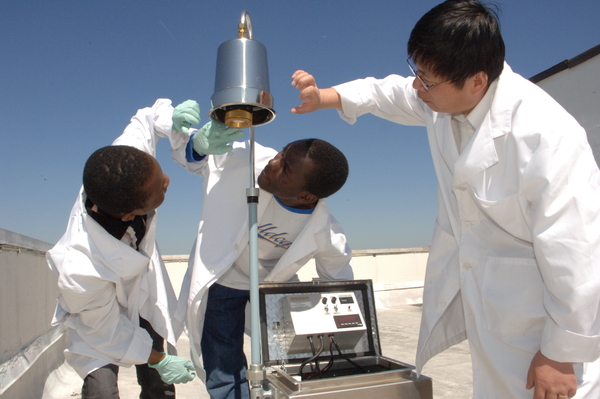
Posted By: Dervedia Thomas on May 12, 2011 A trace amount of iodine-131, a radioactive material possibly stemming from Japan’s Fukushima Daiichi Power Plant accident, has been detected by Dr. Zheng Chang, visiting associate professor of radiochemistry and director of the Applied Radiation Sciences Laboratory (ARSL) at SC State University. The university professor and several radiochemistry students have been monitoring air samples in the Orangeburg area in wake of Japan’s nuclear power plant crisis, triggered by a massive earthquake and 30-foot tsunami on March 11. Chang notes that the amount detected poses no significant health risk to the Orangeburg community, which is consistent with state media reports announced earlier this week. Chang and his students will continue to monitor the radioisotope levels. Chang, along with his students, installed an air sampler on the rooftop of Sojourner Truth Residential Hall on SC State’s campus, the tallest building in Orangeburg, S.C. on March 15, three days after the first explosion at the power plant in Japan. “The jet stream will take about four days to carry gaseous radioactive materials from Japan to the U.S. West Coast, so we knew it was important to begin monitoring the atmosphere for radioactive materials right after the accident,” said Chang. On March 29, Chang announced the detection of iodine-131 from the sample collected March 18-March 21. “The results of Dr Chang’s work is what we call qualitative information,” said Dr. Kenneth Lewis, dean of the College of Science, Mathematics, Engineering and Technology at SC State. “It shows that nuclear material is present in the atmosphere. Dr. Chang is now working to quantify it. Within a week or two, the exact concentrations of the radioactive materials will be known.” Lewis and Chang were awarded a three-year $450,000 grant from the U.S. Department of Energy’s Office of Environmental Management to carry out research in environmental radiochemistry. This project complements Chang’s 1890 Research & Extension study which monitors natural radioactivity in the groundwater in the Midlands and Low Country of South Carolina. According to Chang, the research will help estimate the environmental impact of the accident and establish SC State as a monitoring station in the nation’s southeast region, which could serve as a regional staging area in the event that a nuclear situation occurs in the state. Nuclear engineering program possible resource to S.C. nuclear industry When Dr. Kenneth Lewis, dean of the College of Science, Mathematics, Engineering and Technology, came to SC State in 2005 to direct the nuclear engineering program --then a three-year old academic program-- he began efforts to enhance it. Lewis, a 27-year nuclear engineering veteran, structured the program so SC State could train future nuclear engineers and scientists and establish the university as an auxiliary site for possible nuclear incidents in the state. Of the nation’s 104 nuclear power plants, the Palmetto State has four power plants and a total of seven reactors. SC State is centrally located among the state’s several existing nuclear facilities. Lewis worked to obtain nearly $10 million in grant funding used for student scholarships and faculty support and to purchase advanced nuclear equipment. Ancillary academic support programs such as radiochemistry and health physics were added as concentrations in chemistry and physics, respectively. The ARSL was also established and outfitted with equipment useful for detecting radiation levels on materials and people as well as measuring and analyzing other data. Additionally, under Lewis’ leadership, the program was awarded accreditation in 2008 from the Accreditation Board for Engineering and Technology, a historic gain for the university. Chief among the nuclear engineering program’s goals is training and producing the next generation of nuclear scientists and leaders in the nuclear energy field. By May 2011, the program will have produced about two dozen graduates. Alumni of the program have pursued graduate degrees at prestigious universities such as the University of Florida, University of Maryland, Texas A&M University and University of Wisconsin-Madison. The program also produced the first African-American female to receive a Master of Science in nuclear engineering from North Carolina State University. In addition, the program hosts the Summer Nuclear Science Institute, which introduces selected high school sophomores, juniors, seniors as well as high school guidance counselors to the myriad areas of nuclear science and engineering, including nuclear medicine, non-destructive analysis, space applications, commercial products and nuclear power. Chemical engineering research may lead to advancements in nuclear reactors Two SC State chemical engineers are in the initial stages of conducting thermo-hydraulic research which may lead to advancements in core cooling and steam generation in nuclear reactors. Dr. G. Dale Wesson, professor, vice president for Research, Economic Development and Public Service and executive director of 1890 Programs and Dr. Shawn Austin, post-doctoral research associate, are investigating the fluid dynamics and heat transfer of the alloy, lead bismuth eutectic (LBE), in a yet-to-be-designed nuclear reactor. The micro reactor, 4-feet wide and 7- feet high, will generate enough power for 20,000 families and will be easily transportable. Unlike the water-cooling nuclear reactors in Japan, use of the LBE in the proposed nuclear reactor will optimize efficiency of heating because, in comparison to water, it has improved thermal properties, also making it an ideal coolant for nuclear reactors. The research is funded through the National Nuclear Security Administration’s Massie Chairs of Excellence Program, to which Wesson was appointed, fall 2010. Nuclear energy’s future in the U.S. While legislators, nuclear scientists and environmentalists debate on the future of nuclear energy in the United States in light of the nuclear crisis in Japan, Lewis, who was awarded the 2010 Arthur Holly Compton Award for his contributions to nuclear engineering and science, says nuclear energy expansion in the U.S. will have a short lapse but eventually increase with improved safety measures. “The impact of the nuclear situation in Japan calls for greater attention to nuclear safety. We will likely experience a brief depression of [nuclear reactor] construction in the U.S., because officials will want to ensure safety. But we are an energy-dependent nation,” said Lewis. For more information on SC State University’s nuclear engineering and science programs, contact Dr. Kenneth Lewis, dean of the College of Science, Mathematics, Engineering and Technology at (803) 378-1508 or klewis31@scsu.edu. If you enjoyed this article, Join HBCU CONNECT today for similar content and opportunities via email! |
 |
Dervedia Thomas
Copy Editor, Health Matters Magazine Member Since August 2008 |
Comments
More From This Author
Latest Blogs
 |
Africa’s early influence on Europe: A forgotten pre‑Moorish legacyAn illustration depicting Africa’s early influence on Europe, showing African rulers, scholars, manuscripts, artifacts, and trade goods alongside a map of Africa and Europe, with arrows representing c ...more
Joel Savage • 55 Views • October 8th, 2026 |
 |
Innovate.Research.Advance🚀 Ready to level up your career with a funded internship or fellowship?
Join us tomorrow for a special web event held in partnership with The South Big Data Innovation Hub.
Hear directly ...more
David Lockett • 64 Views • October 7th, 2026 |
 |
The silent battles people fight behind their smilesA person sits quietly near a window, showing emotional depth behind a calm smile.
Every day, people move through the world carrying burdens no one else can see. Behind warm greetings, polite conv ...more
Joel Savage • 87 Views • October 7th, 2026 |
 |
Gospel Music Icon MARVIN SAPP Returns With New Single "He's Not Finished"@MARVINSAPP #MARVINSAPP
Gospel music icon MARVIN SAPP returns with “He’s Not Finished,”
the single was released 8.21.26 is a stirring declaration of faith, perseverance and God’s continuing work i ...more
LaMarr Blackmon • 75 Views • October 6th, 2026 |
 |
The art of making your home feel warm and welcomingA photo of a warm and welcoming living room with soft, lighter tones, natural textures, comfortable seating, and gentle lighting that creates a cozy, inviting atmosphere.
Buying or building a ho ...more
Joel Savage • 84 Views • October 6th, 2026 |
Popular Blogs
 |
Divorce in America in 2009 – What’s love got to do, got to do with it?
Join Brother Marcus and the cast and the crew of the Brother Marcus Show live this Sunday evening on February 1, 2009 @ 8:00 p.m. for another hot topic in our community! “Divorce in America in 2009 ...more
Brother Marcus! • 75,461,067 Views • January 27th, 2009 |
 |
VISINE ALERT!!!Seemingly innocent medication such as Visine eyedrops are used by people to concoct a mixture with similar effects as a date-rape drug.
When mixed with alcohol and taken orally, the eyedrops can l ...more
Siebra Muhammad • 122,620 Views • May 23rd, 2009 |
 |
"Chain Hang Low" check out the real meaning of the Lyrics!Recently there is a new artist out of Saint Louis that goes by the name JIBBS. Jibbs debut single "Chain hang low" has a history that most people are not aware of. The particular nursery rhyme that th ...more
Tyhesha Judge-Fogle • 81,537 Views • November 9th, 2006 |
 |
HBCU Marketplace Gifts: Divine 9 Premium Fraternity / Sorority Playing CardsVendor: Charles Jones
Item Price: $20.00
Price Includes Shipping: Yes - Shipping Included
Item Description:
Pantheon Series - Divine 9 - Premium Playing Cards (choose Gold Series or Silve ...more
Hija Chang • 64,646 Views • December 2nd, 2018 |
 |
Black College Student Sentenced to 12 Years in Prison for Kissing a White GirlAlbert N. Wilson, a former University of Kansas student, has been sentenced to 12 years in prison and a lifetime of probation after being convicted by an all-white jury of raping a white teen girl. Bu ...more
Roger The Great • 57,412 Views • June 4th, 2020 |


