






HBCU Guarantee Money From Playing D-1 Schools Could Dry Up
|
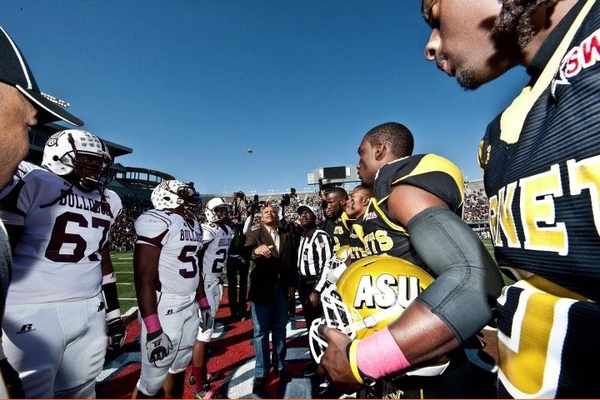
Posted By: Reginald Culpepper on February 20, 2014 From ESPN By Mark Schlabach When Savannah State football coach Earnest Wilson III went searching for future opponents a few weeks ago, he called FBS programs like Iowa and Miami, the kind of deep-pocketed athletics departments that are capable of writing the Tigers six-figure checks in exchange for being a sacrificial lamb for one Saturday. "Iowa told me they couldn't do it," Wilson said. "Other programs told me they couldn't." As major college football moves to the four-team College Football Playoff this coming season, in which two national semifinals and a championship game will determine the sport's national champion, cash-strapped HBCUs (historically black colleges and universities) like Savannah State are being further squeezed out of the equation. Strength of schedule is one of the criteria the 13-member selection committee will consider when choosing four teams for the playoff, so FBS teams are less willing to pay FCS opponents such as Savannah State for what would probably be an easy victory. "It is kind of unchartered waters with strength of schedule being what's going to be looked at," said Southwestern Athletic Conference commissioner Duer Sharp. "Our schools just have to be smart. There are different ways to make money, and you've got to be smart about it." The Tigers, who went 1-11 in Wilson's first season in 2013, were able to secure road games at Middle Tennessee State, FBS transitional foe Georgia Southern and BYU this coming season. They'll make $275,000 for playing the Blue Raiders, $175,000 for playing the Eagles and $405,000 for playing the Cougars. What Savannah State will be paid from guarantees for road games in 2014 ($855,000) will be one of its largest revenue streams and will help fund an athletics program that fields six men's and seven women's teams. But beyond this coming season, programs like Savannah State aren't sure the big-payday games will still be available to help them balance their budgets. In February 2013, Big Ten schools agreed not to schedule FCS opponents in the future. Other FBS conferences such as the ACC and SEC are considering playing nine-game league schedules in coming seasons, eliminating non-conference games that might have otherwise gone to an FCS team. "It's always a concern anytime the landscape changes because you don't know how the changes will affect you," said Savannah State athletics director Sterling Steward Jr. Without the big paydays from FBS teams, HBCU athletics departments will have to stretch their budgets even further than what they already have. According to documents obtained by ESPN.com through state open records laws, Savannah State's entire athletics department is operating on a budget of about $4.5 million this year, which is among the lowest in NCAA Division I. The budget covers everything from coaching salaries to equipment, game operations and scholarships. By comparison, the University of Georgia will pay its 10 on-field football coaches about $6.4 million this year. UGA has an overall athletics budget of more than $93 million, with nearly $16 million dedicated solely to football. "For us, keeping up with everybody else went away a long time ago," Sharp said. "Now, it's about being the best we can be. I think we've done a good job of seeing where we are." HBCUs certainly aren't what they used to be. Perhaps no HBCU has a prouder football tradition than Grambling State, where legendary coach Eddie Robinson guided the Tigers to 408 victories in 57 seasons from 1941 to 1997. Robinson built the Tigers into a small-school powerhouse with more than 200 players who played professional football. But the Grambling State program is now a shell of what it was under Robinson. In October, Tigers players took the unprecedented action of refusing to play a game at Jackson State because of the substandard condition of the school's athletics facilities. Players complained about mold and mildew in their locker rooms, unsafe weight-lifting equipment and uncut grass on the practice fields. Grambling State players say they had to buy their own Gatorade and take 12-hour bus rides to away games. Some players even complained of contracting staph infections because of poorly cleaned uniforms. At the time, Grambling State president Dr. Frank Pogue said: "We've had a chance to tell the world that we are broke. Grambling has insufficient funds to do what Grambling needs to do." Grambling State had its state funding reduced by 57 percent over the last several years, according to university spokesman Will Sutton, and its athletics department budget for 2013-14 was about $6.8 million. Its football program is operating on a budget of about $2 million. Pogue said the problems in the football facilities were "symptomatic" of larger issues across the campus. HBCUs have long fought an uphill battle to stay competitive and relevant in the ever-changing world of college athletics. Before larger state universities opened their doors to African-American students, HBCU football teams produced many of the game's greatest players. Pro Football Hall of Famers like Jerry Rice (Mississippi Valley State), Walter Payton (Jackson State), Deacon Jones (Mississippi Valley State), Mel Blount (Southern) and Willie Lanier (Morgan State) played at HBCUs before becoming NFL stars. Many HBCUs are still known for their festive game-day atmospheres, which include elaborate halftime shows by their famous marching bands. But over the last few decades, as more and more African-American students opted to attend larger universities and bypassed the HBCUs some of their parents attended, HBCUs have been plagued by declining enrollments and drastically reduced state funding. As HBCUs have struggled to maintain their football facilities and secure stability in their coaching staffs, their on-field product has suffered, too. In 2013, only two HBCU players were selected in the NFL draft (twice as many as the previous year). "The pool of candidates is so different now than it was 30, 20 or even 10 years ago," said Senior Bowl executive director Phil Savage, a former NFL general manager, scout and coach. "There was such a tradition with those schools. So many players had family ties to Jackson State or Grambling. That's kind of lost in translation now with people not having that history. It's like it skipped a generation or two. There has been kind of a break in the chain." When Savage moved from coaching to scouting with the Cleveland Browns in 1993, his first assignment was going to every HBCU from Prairie View A&M University in Texas to Delaware State. He covered nearly 30 schools, including a few non-HBCUs, in about eight weeks. Savage recalled almost every HBCU producing a perennial NFL All-Pro selection. Now, Savage struggles to find potential NFL prospects from HBCUs to invite to the Senior Bowl. This year, Tennessee State guard Kadeem Edwards was the lone HBCU player invited to play in the Senior Bowl, a showcase for NFL scouts, coaches and general managers. Jackson State cornerback Qua Cox was added to the roster as an injury replacement late in the Senior Bowl week. "I really make an effort to include the best HBCU prospects in the game, but it's not a given they're going to be taken in the third, fourth or fifth rounds [of the NFL draft]. They're guys that teams are going to take a flyer on." Former NFL defensive back Aeneas Williams, who was elected into the Pro Football Hall of Fame in February, played one season at Southern University in Baton Rouge, La., before spending more than a decade with the Arizona Cardinals and St. Louis Rams. Williams said HBCUs have a more difficult time recruiting top players because there are so many more options available now. "Look at Louisiana," Williams said. "Louisiana-Lafayette is a viable football program. Louisiana-Monroe and Tulane are viable programs. In the past, if a kid from Louisiana didn't go to LSU, he might have gone to Southern or Grambling. The talent pool is still there, but now it's dispersed more. It's incumbent upon the HBCUs like Grambling and Southern to maximize what they do have. That's going to be the key going forward." The recent Grambling State controversy brought awareness to the financial problems being endured by many HBCU athletics departments across the country. According to the most recent budget figures submitted to the Office of Postsecondary Education, most HBCU athletics departments are operating on shoestring budgets compared to other FCS programs. In the Mideastern Athletic Conference (MEAC), South Carolina State had the deepest pockets among 11 HBCUs with an athletics department budget of about $12.7 million in 2012-13. In the 10-team Southwest Athletic Conference (SWAC), Alabama State had the largest budget of about $11.7 million. Thirteen of the 21 MEAC and SWAC schools had athletic budgets of less than $10 million in 2012-13, including Mississippi Valley State, which was operating on about $4.4 million per year. During the same time, Texas and Florida reported operating budgets of more than $165 million and $129 million, respectively. Even other FCS programs like Appalachian State ($20.9 million) and North Dakota State ($18.8 million) had operating budgets that more than tripled those of some HBCUs. "It's a huge disadvantage," Sharp said. "For schools with the small budgets, you're even more locked into guaranteed games. Not only in football and men's basketball but even in women's basketball. You're asking the women's basketball team to go on the road to generate money." The smaller budgets at some HBCUs have caused problems both on and off the field. Savannah State was among 11 HBCUs that were penalized for poor Academic Progress Rate scores in June, which the NCAA uses to grade schools on their student-athletes' eligibility and retention rates. The Tigers are banned from competing in the football postseason this coming season (if they qualify) and will have reduced practice time (16 hours per week, instead of 20). Savannah State's men's basketball team also was hit with reduced practice time for poor APR scores. Alabama State and Mississippi Valley State were the other HBCU football programs facing postseason bans. HBCUs did show some improvement in APR scores in the latest NCAA report, even though their tutoring and academic support programs are much smaller than larger FBS schools. It's just one of the problems that comes with operating with a smaller budget than most NCAA Division I schools. "We like to think we do more with less," Steward said. "Too many [HBCUs] take the approach of no one wants to fool with us and we put ourselves in a little box. We have to broaden our horizons and go places where we need to go." Savannah State has gone wherever it needed to go -- with mostly predictable results. Steward said HBCUs face a dilemma when scheduling games against more talented FBS opponents. Two years ago, the Tigers opened the 2012 season by playing consecutive road games at No. 19 Oklahoma State and No. 6 Florida State, losing by a combined score of 139-0. Steward was heavily criticized for scheduling the games for money and putting his coaches and players in a position to get embarrassed. But Steward said Savannah State's athletics department used the $850,000 it received for playing the Cowboys and Seminoles to invest in its program's future. The Tigers used part of the money to hire a full-time strength and conditioning coach, two strength and conditioning assistants, new film editing equipment for recruiting, as well as knee braces and other needed equipment for players. Steward said even though the scores might have been lopsided, it was an experience many Savannah State players will never forget. When the Tigers played at Oklahoma State, it was the first time the school chartered a flight for a road game. It was also the first time the Tigers played in a stadium with a capacity of more than 60,000. "If you're Division I, you shouldn't be afraid of anyone," Steward said. "We thought it would be a good experience and good measuring stick for us. We left the game without any injuries. The only thing bruised was the scoreboard." Last season, the Tigers played at No. 16 Miami and lost, 77-7. Savannah State received $375,000 for playing the Hurricanes. "As soon as we got back to campus, the players were asking me who we were going to play next," Steward said. Wilson, 48, has been on both sides of the lopsided scores. He worked as a graduate assistant under Penn State's Joe Paterno during the early 1990s and also coached at New Mexico State. But Wilson has spent most of his career at HBCUs like Alabama A&M, Benedict (S.C.) College, Elizabeth City (N.C.) State, Hampton and Jackson State. "Before Boise State was Boise State, they were playing these games and were getting blasted," Wilson said. "This is how programs were built. They went out and played these games and got their butts kicked." Savannah State is trying to utilize creative ways to generate money. Along with hosting golf tournaments, coaching clinics and youth camps, the Tigers are leasing their football stadium to one of the largest private high schools in Savannah. They've signed sponsorship deals with more local businesses and signed a broadcast agreement with a local TV station to televise games. The efforts have helped endow two football scholarships over the past couple of years. The Tigers also are cutting costs wherever possible. Instead of having a marketing and promotions department to operate the athletics department's Web site and organize pep rallies and halftime shows, Savannah State started a marketing club so students could be more involved in the day-to-day operations of the athletics department. "We think we're only scratching the surface," Steward said. "We haven't even started to do what we think we can do." Wilson has also used his connections in the coaching fraternity to help the Tigers supplement their equipment with refurbished shoulder pads and helmets from FBS programs, which might have discarded them after only a season or two. Savannah State's coaches can now brag to recruits about having 18 different uniform combinations. "We're not Oregon, where they have 56 or 67 uniforms," Wilson said. "But we do have multiple uniforms." Wilson and his coaching staff have focused their recruiting efforts within a six-hour radius around Savannah to cut down on travel costs. Wilson estimates his staff spent about $25,000 on recruiting this past season (UGA spent $600,000, according to school officials), and 23 of the Tigers' 30 signees were from Georgia high schools. Wilson is still working without a secretary and director of football operations, so he's carrying most of the weight when it comes to recruiting. "There aren't too many things I've asked for that they haven't delivered," Wilson said. Without guaranteed games in the future, HBCUs will face an even steeper climb. Although the SWAC has traditionally played guaranteed games against SEC opponents, Sharp said his league's schools might have to look for other revenue streams in the future. The "classic" games, in which HBCU opponents play in neutral sites like Atlanta, Houston, and New Orleans, might be an attractive option. Two of the SWAC's most anticipated games of the season pit Alabama A&M against Alabama State in the Magic City Classic in Birmingham, Ala., and Grambling against Southern in the Bayou Classic in New Orleans. "That's the great thing about the SWAC and HBCUs," Sharp said. "You can have any of our schools play on a neutral site and it's going to attract a crowd. I think you'll see more of the classic matchups pop up in the future." South Carolina State generated more than $1 million from guaranteed games last season, much of it coming from "classic" games. The Bulldogs were paid $100,000 (plus potentially another $150,000 in ticket sales, minus travel expenses) to play Benedict College in the Palmetto City Classic in Columbia, S.C., and $240,000 (minus expenses) to play North Carolina A&T in the Atlanta Football Classic, according to contracts obtained from the school. South Carolina State also made $275,000 for playing at Clemson. Like other HBCUs, Savannah State can only hope brighter days are ahead -- both on and off the field. If not, Wilson says, the Tigers will keep rolling up their sleeves and going to work. "We've got to start building a program," Wilson said. "We have to do what they did at Texas Tech. We have to do what they did at Boise State and San Jose State. You have to start from somewhere. If you don't have a vision, you're dead." Orginal Story At http://espn.go.com/college-football/story/... If you enjoyed this article, Join HBCU CONNECT today for similar content and opportunities via email! |
 |
Reginald Culpepper
President, Fulfillment and Web Services, HBCUCONNECT Clark Atlanta University class of 1998 Member Since September 2000 |
Comments
More From This Author
Latest News

 |
Rosen Foundation expanding scholarship program, partnering with Bethune-Cookman UniversityCarrying on the legacy of Harris Rosen and his commitment to education, today the Harris Rosen Foundation announced it is expanding its already-successful scholarship program and partnering with Bethu ...more
Reginald Culpepper • 304 Views • May 19th, 2026 |
 |
Sinners vs. Michael: Which Film Actually Won the Ultimate Culture Debate?While Antoine Fuqua’s Michael is dominating the box office with its electrifying, stadium-level concert recreations and a star-making, uncanny physical performance by Jaafar Jackson, critics and film ...more
TaQuan Ford • 234 Views • May 16th, 2026 |
Popular News



 |
North Carolina HBCU Unity DayShaw University - Elizabeth City State University - Johnson C. Smith University - Fayetteville State University - Livingstone College - North Carolina A&T State University - North Carolina Central Uni ...more
Reginald Culpepper • 109,468 Views • August 8th, 2016 |


