







Black Colleges Matter
|
Posted By: Reginald Culpepper on August 28, 2015 By Alexander Nazaryan 8/18/15 at 4:37 AM Coutesy of NewsWeek - http://www.newsweek.com/black-colleges-matter-363667 Medgar Evers College, an overwhelmingly black branch of the City University of New York, sits atop a hill in central Brooklyn. It is across the street from the mustard-colored high-rises of the Ebbets Field Apartments, named for the long-gone baseball field where the Brooklyn Dodgers played until 1957, and where Jackie Robinson had broken the color barrier in major league baseball in 1947. Medgar Evers is a cluster of newish glass-and-brick buildings that radiate competence and promise. The college’s crest shows the scales of justice, a lamp and a pair of hands struggling against shackles. In 1987, A Different World premiered on NBC, introducing the nation to Hillman College, attended by Cosby Show scion Denise Huxtable. Stodghill argues that the show “did more to attract black college kids to black campuses than those ‘A Mind Is a Terrible Thing to Waste’ public service announcements ever could.” While acknowledging the recent grave accusations of sexual assault against Bill Cosby, he describes the embattled actor as one of the nation’s most vociferous (if sometimes hectoring) proponents of black intellectualism. The $20 million gift Cosby and his wife made to Spelman in 1988 remains an act of unrivaled generosity in the HBCU world. “If we can tithe for our churches, we can tithe for our schools,” Spelman’s president at the time said of the gift. But that hasn’t happened. The Cosbys’ largesse aside, HBCUs don’t attract large philanthropic gifts. This may be because many of those who attend HBCU come from less wealthy households, but that doesn’t explain it all: Some psychological hesitation is obviously at work. When the musician and entrepreneur Dr. Dre donated $35 million to the University of Southern California in 2013, many saw it as a betrayal of his people. “I can’t help but wish that Dre’s wealth, generated as it was by his largely black hip-hop fans, was coming back to support that community,” lamented the president of Dillard University in a Los Angeles Times op-ed. The head of the Thurgood Marshall College Fund quips to Stodghill that “our funding comes from Republican rich white guys and their wives,” an apparent reference to the $25 million gift from the Koch brothers to the United Negro College Fund in the summer of 2014. This clearly dismays Stodghill, who calculates that “HBCUs boast 2 million living alumni; if 2 million graduates pledged even a hundred dollars a year, HBCUs could build endowments all over the country. But for some reason, blacks refuse to fund our own schools.” The federal government hasn’t made life for HBCUs easier, adding stricter credit rating requirements to the crucial Parent PLUS loan program in 2011 while also reducing by six semesters the length of Pell Grants, on which close to 90 percent of HBCU students are estimated to rely. If neither the private nor the public sector will rescue the HBCUs, who will? One administrator tells Stodghill that “the HBCU president has the toughest job in higher ed. We’ve got the same expectations, but not even near the resources of the people you’re competing with.” Brown, the poorest of the Ivies, has an endowment of $3.2 billion; Howard, the wealthiest of the HBCUs, has an endowment one-fifth of that, $586.1 million. The intellectual value of an HBCU education is coming into question too. The old “teacher and preacher” model of instruction, which recalls an antiquated black culture, is out of sync with the demands of the 21st century. Stodghill talks to a Morehouse professor who laments that “most HBCUs curriculums today do not emphasize discussion and debate.” The professor says he has his students approach classroom work “like an Ivy League school,” the implication being that many of his peers do not. Stodghill, who’s never particularly optimistic in his book, points to an estimate that there will be only 35 HBCUs in 2035, down from 104 today (some put the number at 106). Of those, Stodghill writes, only 15 will be “actually thriving.” The rest will continue to shrink, consolidate or close, disappearing eventually from the landscape of American higher education, taking a vital part of our shared national history with them. Perhaps the HBCUs’ decline is a sign that our society truly is becoming post-racial. Note that neither America’s first African-American president nor the first lady have ties to an HBCU: President Obama went to Columbia, his wife, Michelle, went to Princeton. In fact, many of the nation’s most prominent African-Americans also have ties to the Ivy League: Shonda Rhimes (Dartmouth), Loretta Lynch (Harvard), John Legend (Pennsylvania), Neil deGrasse Tyson (Harvard), Eric Holder (Columbia). “One of the byproducts of racial segregation,” Stodghill writes, “was that black colleges enjoyed a critical mass of really smart students and really bright teachers whose options were also limited.” To romanticize segregation is an odd position, but Stodghill isn’t the first to wax nostalgic for a fiercely ambitious black cultural unity in the face of a prevalent white hatred. Today, that kind of unity isn’t necessary and, in fact, may be seen a sign of weakness or parochialism. Like the Lower East Side Jews of earlier generations who spurned “the Harvard of the Proletariat” that was the City College of New York for the actual thing in Cambridge, Ivy-bound blacks like those aforementioned wanted to—and did—prove themselves in the highest echelons of the white establishment. Yet an argument for HBCUs remains. According to the UNCF, black colleges produce 70 percent of all black dentists and doctors, 50 percent of black engineers and public school teachers, and 35 percent of black lawyers. And while HBCUs account for only 3 percent of the nation’s colleges, they account for about 20 percent of the degrees awarded to African-Americans. There is a less quantifiable argument too. When, several months ago, video emerged of fraternity members at the University of Oklahoma singing a racist chant, it offered a stinging reminder that just because black students are allowed into predominantly white institutions, they are not always welcome in them. Stodghill writes of one black corporate lawyer who was raised in relative privilege in the 1980s and went to the University of Michigan, only to transfer to Florida A&M University, an HBCU in Tallahassee. When asked later what it was like to attend FAMU, he answered, “Probably what it feels like to be a white dude at the University of Michigan.”
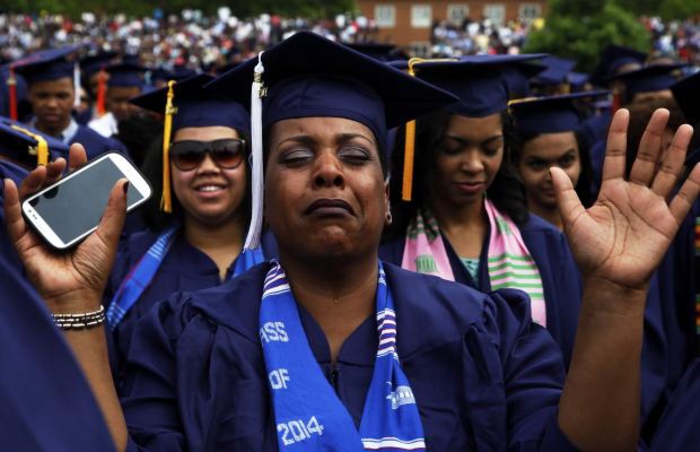
Photo and Photo Credit: A graduate cries during a prayer at Howard University's 2014 graduation ceremonies in Washington, D.C. Black colleges are facing tough times as endowments shrink and African-American students enroll elsewhere. Jonathan Ernst/Reuters
If you enjoyed this article, Join HBCU CONNECT today for similar content and opportunities via email! |
 |
Reginald Culpepper
President, Fulfillment and Web Services, HBCUCONNECT Clark Atlanta University class of 1998 Member Since September 2000 |
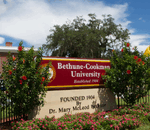 |
Rosen Foundation expanding scholarship program, partnering with Bethune-Cookman UniversityCarrying on the legacy of Harris Rosen and his commitment to education, today the Harris Rosen Foundation announced it is expanding its already-successful scholarship program and partnering with Bethu ...more
Reginald Culpepper • 281 Views • May 19th, 2026 |
 |
Sinners vs. Michael: Which Film Actually Won the Ultimate Culture Debate?While Antoine Fuqua’s Michael is dominating the box office with its electrifying, stadium-level concert recreations and a star-making, uncanny physical performance by Jaafar Jackson, critics and film ...more
TaQuan Ford • 222 Views • May 16th, 2026 |
 |
Healthcare Career Fair Aims to Connect Employers with Qualified Local Talent in Northern VirginiaHealthcare organizations across Northern Virginia will have an opportunity to connect directly with qualified job seekers this June during the upcoming Healthcare Career Fair in Prince William County. ...more
Reginald Culpepper • 407 Views • May 15th, 2026 |



 |
North Carolina HBCU Unity DayShaw University - Elizabeth City State University - Johnson C. Smith University - Fayetteville State University - Livingstone College - North Carolina A&T State University - North Carolina Central Uni ...more
Reginald Culpepper • 109,431 Views • August 8th, 2016 |


