







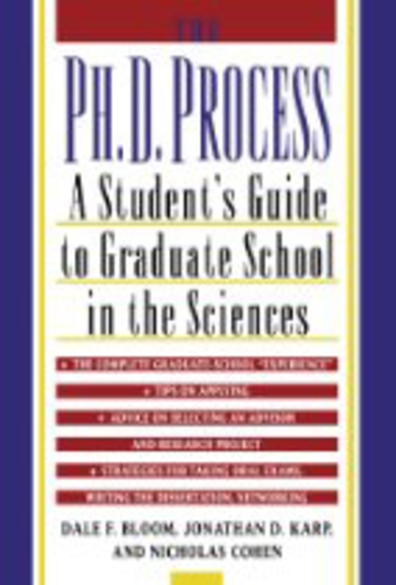
Grad Student Ways Top Pick: The Ph.D. Process: A Student's Guide to Graduate School in the Sciences
|
Posted By: Hija Chang on March 02, 2016 By Dale F. Bloom, Jonathan D. Karp, Nicholas Cohen Price: $19.95 & eligible for FREE Shipping on orders over $35. Product Description The Ph.D. Process offers the essential guidance that students in the biological and physical sciences need to get the most out of their years in graduate school. Drawing upon the insights of numerous current and former graduate students, this book presents a rich portrayal of the intellectual and emotional challenges inherent in becoming a scientist, and offers the informed, practical advice a "best friend" would give about each stage of the graduate school experience. What are the best strategies for applying to a graduate program? How are classes conducted? How should I choose an advisor and a research project? What steps can I take now to make myself more "employable" when I get my degree? What goes on at the oral defense? Through a balanced, thorough examination of issues ranging from lab etiquette to research stress, the authors--each a Ph.D. in the sciences--provide the vital information that will allow students to make informed decisions all along the way to the degree. Headlined sections within each chapter make it fast and easy to look up any subject, while dozens of quotes describing personal experiences in graduate programs from people in diverse scientific fields contribute invaluable real-life expertise. Special attention is also given to the needs of international students. Read in advance, this book prepares students for each step of the graduate school experience that awaits them. Read during the course of a graduate education, it serves as a handy reference covering virtually all major issues and decisions a doctoral candidate is likely to face. The Ph.D. Process is the one book every graduate student in the biological and physical sciences can use to stay a step ahead, from application all the way through graduation. Product Details Amazon Sales Rank: #777845 in Books Published on: 1999-02-25 Original language: English Number of items: 1 Dimensions: 6.10" h x .60" w x 9.00" l, .73 pounds Binding: Paperback 224 pages Editorial Reviews Review "Graduate school . . . is the only established route to advanced study of the nature of the universe. It culminates in the award of a doctoral degree but requires some advanced and very specialized courses, an 'independent research project,' a thesis or dissertation, passing very intense exams or other requirements, and, last but not least, interactions with other students, faculty, both on and off campus at conferences and other relevant sites. Bloom, Karp, and Cohen have gone into considerable and realistic detail about this 'life experience' and have taken a viewpoint as an advocate of the student. No graduate school catalog I have ever seen has given a list of disclaimers, disclosures, hidden hurdles, barriers, possibilities for disaster, the culture of science and the sociology of scientists, and stress generators, let alone any hints on how to over come any of these problems. This book goes a very long way to helping to fill in those gaps and omissions."--scientistlifeboat.com "[T]he most comprehensive guide to date about graduate school in the sciences. . . . The Ph.D. Process marches through all aspects of the grad school experience, from application through dissertation defense, and includes some excellent topics not covered in other books, such as advice to foreign students. . . . In addition, the book includes the voices of graduate students themselves, discussing, and in some cases qualifying, the authors' advice. The combination of authoritative summaries along with anecdotes from students themselves help lend substance to what otherwise might be a daunting litany of do's and don'ts about grad school. The book is organized in a more or less chronological sequence of major events and issues in the grad school process. Interspersed with these subjects are chapters on more strategic and issues-related subjects . . . Together the chapters work both to explain how things work and also how to make things work well for you."--Science's Next Wave From the Publisher Oxford University Press: Drawing upon the insights of numerous current and former graduate students, this book present a rich portrayal of the intellectual and emotional challenges inherent in becoming a scientist, and offers the informed, practical advice a "best friend" would give about each stage of the graduate school experience. From the Author Graduate school in the sciences is not similar to undergraduate education, where the passing of a sufficient number of courses usually guarantees one a degree; neither is it like medical school or law school, where there is a delineated and set curriculum. Science Ph.D students are actually pretty much on their own--and they will sink or swim depending upon their own interpretation of how the system works. The purpose of this book is to provide students with some insight into this unusual system. The authors, PhDs themselves, reveal the generally unspoken "rules" of the game. They offer the secrets of survival and success: What should you discuss in your application essay? What types of research advisors should you avoid? What kinds of research projects should you never undertake? How hard do you have to work? Are grades important? What steps should you take now to make yourself employable when you finish? What decisions can make or break your career? How can you network in the scientific community? What goes on at the oral defense, and how can you prepare? Described also is the daily experience itself: research life, classes, seminars, journal clubs, lab meetings, interactions with peers and professors, qualifying exams, professional meetings, oral exams, dissertation preparation, etc. Anxiety, frustration, and joy-- all normal responses to a grad student's life--are also examined. (In quotes sprinkled throughout the text, numerous past and present grad students relate their individual experiences and emotions during their doctoral training.) A separate chapter is devoted to the special problems of foreign students, strangers to our culture and educational system. There are many intellectual and emotional challenges inherent to becoming a scientist. This book prepares students for each stage of the experience. They will learn what to expect--socially, psychologically, and academically! Customer Reviews Most helpful customer reviews 28 of 28 people found the following review helpful. What Grad School is Really Like By Audiaa The PhD process is a great overview of graduate school in the sciences. It covers most basic topics such as choosing a type of school, applying, preliminary exams, comps, thesis work, etc. Of course each school does these things slightly differently, but the main points are there and the authors do a good job of pointing out where differences between programs are likely to turn up. This book also explains things that graduate programs aren't likely to advertise such as using students as `cheap labor' and what things to look for in an advisor other than interesting research. This is a fun to read honest book, and the anecdotes from current and past graduate students are the best part. I enjoyed reading them because so many of the same things have happened to me, and it's nice to know that I'm not alone. I wouldn't say that I received any great insights from the book because I had some experience with academic labs before I applied to graduate school and had a pretty good idea of what I was getting into. I found it a little calming to read about others' experiences as I was waiting to get started. I think most students who apply to graduate school have already spent much time in labs with current graduate students so this might not be that useful to them as practical advise; however, I found this book to be an excellent resource for my parents. My parents had no idea what graduate school is like, and the fact that I'm at school all day and only go to class for an hour baffles them to no end. Reading this book helped them to understand the structure and goals of graduate school. Though I still don't think they understand journal club. (Why would anyone join that club? It doesn't sound like very much fun.) I recommend this book to grad students for their parents or to undergraduates who aren't sure if graduate school is the right path for them. This book gives great insight into what graduate school is really like. 16 of 16 people found the following review helpful. What you've always wanted to know about graduate school. By A Customer This is the first book I've seen that deals with the opportunities and challenges of being a graduate student in the sciences in a fair and equitable fashion. You'll find neither university-specific recruitment cheerleading nor intellectual snobbery in this book, just what the reality of life is like for students in graduate school. And make no mistake - this reality is very personal. From choosing a graduate school to tying up the loose ends of your dissertation, this book explains just what you can expect from this exhilarating, unnerving, and sometimes overwhelming experience. I wish this book had been available when I was applying to graduate schools! I highly recommend it to anyone, whether they are simply considering going to graduate school or are weeks away from a defense date. Being a graduate student in the sciences can be very isolating, and reading about other students' experiences that echo your own (especially in other universities around the country) provides a sometimes much-needed perspective on both your feelings and your attitudes about your current work and your upcoming career. If you are considering a Ph.D. in the sciences, READ THIS BOOK. 15 of 15 people found the following review helpful. By A Customer The following was copied from another website's review of The Ph.D. Process, and I think it describes the book perfectly: Graduate school in science is not an experiential extension of undergraduate education, where the passing of a sufficient number of courses usually guarantees one a degree; nor is it medical school or law school, where there is a delineated and set curriculum. Ph.D students are actually pretty much on their own--and they will sink or swim depending upon their own interpretation of how the system works. The purpose of this book is to provide students with some insight into this unusual system. The authors--each a Ph.D. in the sciences--reveal the generally unspoken "rules" of the game. They offer the secrets of survival and success: What should you discuss in your application essay? What types of research advisors should you avoid? What kinds of research projects should you never undertake? How hard do you have to work? Are grades important? What steps should you take now to make yourself "employable" when you finish? What decisions can make or break your career? How can you network in the scientific community? What goes on at the oral defense, and how can you prepare? Described also is the daily experience itself: research life, classes, seminars, journal clubs, lab meetings, interactions with peers and professors, qualifying exams, professional meetings, oral exams, dissertation preparation, etc. Anxiety, frustration, and joy-- all normal responses to a grad student's life--are also examined. (In quotes sprinkled throughout the text, numerous past and present grad students relate their individual experiences and emotions during their doctoral training.) A separate chapter is devoted to the special problems of foreign students, strangers to our culture and educational system. There are many intellectual and emotional challenges inherent to becoming a scientist. This book prepares students for each stage of the experience. They will learn what to expect--socially, psychologically, and academically! Add to Shopping Cart: http://astore.amazon.com/thgrstwa-20/detai... If you enjoyed this article, Join HBCU CONNECT today for similar content and opportunities via email! |
 |
Hija Chang
Management, See Moss Interactive Bellarmine University class of 2021 Member Since January 2011 |
Comments
More From This Author
Latest Graduate School Info

 |
Graduate Student Fellowship Opportunity!We, at www.stemuscenter.org, just completed our first two informational sessions on Research Fellowship opportunity for STEM and Social Science doctoral students.
The mission of our center is to te ...more
Manisha Maurya • 2,180 Views • October 23rd, 2024 |
 |
4 Habits for Success in Online SchoolOnline education has become an increasingly popular option for students over the years, especially due to the current global pandemic. However, succeeding in online school takes more than just a good ...more
Anica Oaks • 2,501 Views • February 1st, 2024 |


Popular Graduate School Info
 |
People Judge Your Intelligence Based on the Tone of Your Voice and How Fast You Speak
Do you want people to think you are intelligent? Has someone ever told you “You’re much smarter than you look.”?
No doubt it can sting to be perceived as less intelligent, particularly when you ...more
Hija Chang • 32,834 Views • June 12th, 2017 |
 |
Magna, Summa, and the Honor RollWhat does it mean to graduate with honors? Academic honors involve these Latin terms...
What is Cum Laude: Graduating With Honor means graduating cum laude. What does cum laude mean? Translators de ...more
Hija Chang • 27,601 Views • March 16th, 2016 |
 |
How to Improve Your Reading Comprehension If youd like to improve your reading comprehension, try the SQ3R method. This is an acronym that means: Survey, Question, Read, Recite and Review.
Heres how it works:
Survey Your Text
Prior t ...more
Hija Chang • 25,409 Views • June 12th, 2017 |
 |
Never procrastinate and always free time…..One blog I read regularly is by Leo Babauta, called zen habits. Essentially, he writes all about simplifying your life. A while ago, Scott Young was a guest blogger for Babuata’s website and wrote a p ...more
Hija Chang • 14,254 Views • April 19th, 2018 |
 |
MVSU to host Graduate Expo March 1Why should you consider an advanced degree? How will you finance your graduate education? What program of study is the best fit for you?
For the answer to these questions and many more, attend Mis ...more
Hija Chang • 13,379 Views • February 27th, 2018 |


