








Opportunity Scholarship Students Featured in NY Times Magazine
|
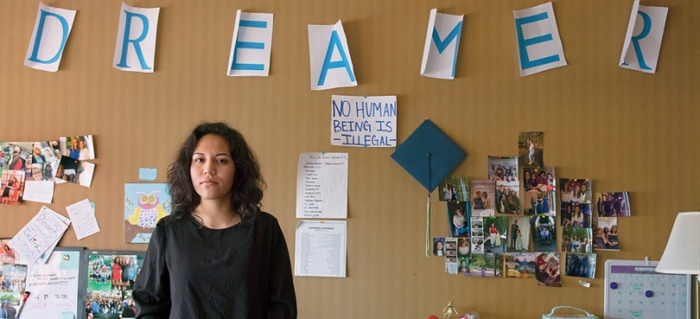
Posted By: Hija Chang on January 31, 2017 The New York Times Magazine published the below article about the Opportunity Scholarship students -- also known as "Dreamers" -- who have been provided access to higher education at Delaware State University. The undocumented children of illegal immigrants, they have grown up in this country, and despite excelling academically in their public schools in states around the country, they were denied enrollment in universities and college in the states where they lived due to the undocumented status. The below article, published in the Jan. 29 edition, tells the story of the challenges they and their families have faced in the U.S., their opportunity at DSU, and their current aspirations. THE ONLY WAY WE CAN FIGHT BACK IS TO EXCEL By Dale Russakoff The New York Times Magazine. When Indira Islas was in third grade at Centennial Arts Academy, a public elementary school in Gainesville, Ga., she decided it was time to get serious. It was 2006, and she was in the lowest reading group her class. She had been in that group since arriving two years earlier, speaking no English, in Gainesville, a city of 38,000 just northeast of Atlanta’s booming outer suburbs. But being at the bottom went against everything she believed about herself. “I wanted to be with the smart kids,” she recalls. Starting the year before, in second grade, she read every volume of the “Magic Tree House” books in her elementary-school library, a series about two ordinary siblings who climb into their backyard treehouse and time-travel to Pompeii, the Wild West, the ice age, feudal Japan and beyond. “I absolutely loved them,” she says. “It was like going on adventures all over the world.” It was also the opposite of her own life. Indira left Mexico for the United States at age 6 with her parents and two younger sisters. Her mother cleaned houses when she wasn’t caring for the children — there would eventually be seven of them — and her father worked in construction, and there was no money for after-school lessons or soccer clubs, let alone traveling. “I’d hear about trips and experiences of my white friends, and I remember thinking: I’ll never go to the beach or Disney World for spring break,” Indira says. Her parents told her that education was all that mattered, and she had to spend all her free time inside, reading and writing. “I tell my children this country is a blessing to all the people living here,” her mother told me. “If you have the opportunity to be good, it’s very important to take it.” Indira took this advice to heart. By the time she was in fifth grade, her reading skills had improved so much that she tested into the top reading group. By middle school, she consistently got A’s, which qualified her for a celebratory school trip every time report cards came out. “They rewarded us by taking us skating or bowling,” she says. “I felt like I was so smart, just getting the chance to go out for the whole school day with friends. That’s when I said: ‘I can make it.’ ” Indira began to throw herself into everything. At recess, she played soccer and basketball, competing so fiercely that everyone took notice. Boys usually picked other boys for their teams, and white kids tended to favor other white kids. But everyone started picking Indira. In middle school, she was on the track team, running long-distance races. Her coach was stunned by her determination. In meets, even when she won her event, she scolded herself unless she broke her previous record. After practices ended, she would keep running. “I wanted to think,” she says. “I’d stay after practice and run and run and run.” Indira remembers understanding vaguely that it wasn’t just poverty that set her and her family apart. Her parents had been doctors in Mexico. She admired pictures in their dresser drawer of the two of them in their 20s standing together, tall and proud in their white coats — before they all fled the violence of drug gangs who were then taking over their home state, Guerrero. When she asked her parents why they were no longer doctors, they explained it was because they were not American citizens. It didn’t make sense to Indira. Why would her father have shed that beautiful crisp white coat for the fraying pants and shirts he now wore? Soon after Indira turned 13, in 2011, she was riding home from track practice with her mother when another car sideswiped the family’s Ford Expedition. The other driver who was at fault, insisted on calling the police, according to Indira and a lawyer who assisted the family. Indira pleaded not to involve the police, explaining that her mother did not have a driver’s license because she was not an American citizen. (In Georgia and most other states, undocumented immigrants cannot obtain driver’s licenses.) But the driver said she needed a police report to get insurance to cover the damage to her car. A police officer arrived and asked for Indira’s mother’s license. When she said she did not have one — a state crime — she was told to get out of the car. Indira got out, too. She remembers two of her younger siblings sleeping in the back, one in a booster seat, one in a car seat. Two elders from the church they attended arrived to ask for mercy. She has seven children, they told the officer. He responded that he was simply enforcing the law. Indira’s mother turned to her and began to cry. “Indira, I don’t know what is going to happen,” she said. “They’re going to take me.” Indira remembers remaining strangely calm. “When she was being handcuffed, I said: ‘Mom, everything is going to be O.K.’ ” More: http://www.desu.edu/news/opportunity-schol... If you enjoyed this article, Join HBCU CONNECT today for similar content and opportunities via email! |
 |
Hija Chang
Management, See Moss Interactive Bellarmine University class of 2021 Member Since January 2011 |
Comments
More From This Author
Latest News
 |
Promote the Vote Fund: Ensuring Every Voice Is Heard in Michigan 28 April 2026
Promote the Vote Fund, a Ford grantee, is a coalition of partner organizations leading these efforts. The organization works across the ideological spectrum to support voting rights for Michiganders ...more
Hija Chang • 79 Views • May 3rd, 2026 |
 |
Temple to open medical campus in Atlantic CityBoth Temple and the Katz School of Medicine are guided by the belief that education and healthcare open doors and transform communities, and that is exactly what we have accomplished in Pennsylvania,” ...more
Hija Chang • 86 Views • May 3rd, 2026 |
 |
Apartheid’s legacy and the rise of xenophobia in South Africa todayPhoto: An image showing a South African township street with closed small shops owned by African migrants, police presence in the background, and community members walking past with tense expressions. ...more
Joel Savage • 319 Views • April 30th, 2026 |
 |
James Artissen, Big Gipp & DJ Burn One - Just Another DayAcclaimed Grammy-Nominated singer-songwriter James Artissen teams up with Southern hip-hop rapper Big Gipp, and respected producer DJ Burn One for their latest release, “Just Another Day.” The record ...more
Lenell Johnson • 204 Views • April 28th, 2026 |
 |
PROPEL Center Launches Future of Tech Innovation Challenge to Spotlight HBCU Talent & Shape the Next Generation of AI LeadersPROPEL Center, the global HBCU technology and innovation hub committed to strengthening the future Black talent pipeline, announced the launch of the Future of Tech Innovation Challenge, a national co ...more
Crystal Willis • 254 Views • April 27th, 2026 |
Popular News



 |
North Carolina HBCU Unity DayShaw University - Elizabeth City State University - Johnson C. Smith University - Fayetteville State University - Livingstone College - North Carolina A&T State University - North Carolina Central Uni ...more
Reginald Culpepper • 108,200 Views • August 8th, 2016 |


