





What is a Manifold? (6/6)
|
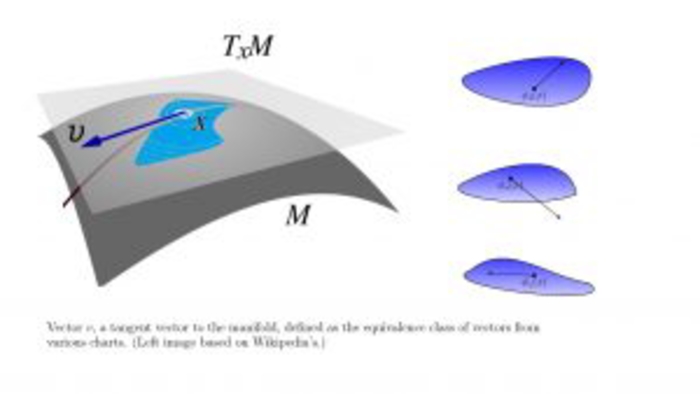
Posted By: Hija Chang on April 28, 2017 FEATURED Content by Behnam Esmayli In posts 1-3 we were able to reduce all of the geometry of a curve in 3-space to an interval [a,b]\subset \mathbb{R} along with two or three real-valued functions. We also discussed when two sets of such data give equivalent (overlapping) curves. This enabled us to patch together a collection of such sets of data into one unified spatial curve. We then studied the specific example of re-defining the metric on the plane so that its geometry is precisely that of a 2-sphere. We saw that for measurements of angles, lengths, and areas, all we need is a dot-product on vectors. Given an open domain in the plane, once we have a dot-product, we will be able to make such measurements. Our goal in this post is to make the following definition of a manifold more tangible. Begin with a topological space X. (Note we cannot talk about any structure other than continuous maps from or to this space.) Assume that for every x \in X, there is an open neighborhood N_x of x homeomorphic to an open domain U_x in the plane: \phi _x : N_x \longrightarrow U_x . These are called “charts”, or coordinate maps. Given this the question now is: How do we make sense of the notions of C^1-ness and length for a curve C\subset N_x\subset X? One way we might hope to do this is by using our coordinate maps. That is we say that C is C^1 if \phi_x(C) is C1 C1 and we define the length of C C to be the length of \phi_x(C). As illustrated in a picture in the previous post, this definition of C^1-ness is not a satisfactory one because some curves will lie simultaneously in two neighborhoods, say U_x and U_y, and there is no guarantee that if its image in U_x is C^1, it must also be C^1 in U_y. However, the two images are transformed to one another by the map \phi _x \circ \phi _y^{-1} : U_y \longrightarrow U_x (See the previous article for the reason.) Therefore, if these “transition maps” between subsets of \mathbb{R}^2 are C^1, then without ambiguity, we can define a subset of X to be a C^1 curve if its image under any (and hence all) of the chart maps is a C^1 curve in \mathbb{R}^2. The space X together with the data of coordinate charts with the properties above is a 2-dimensional C^1 manifold. As sketched above, for such manifolds, it is meaningful to talk about C^1 curves, or C^1 functions f: X \longrightarrow \mathbb{R}. In the latter case, we say f is C^1 if f \circ \phi _x^{-1} is C^1 for all x. Hopefully, now, the idea is starting to make sense. A C^2 manifold is a topological space with charts whose transition maps are C^2. For these manifolds, we can talk about second derivative of functions. A smooth manifold is one with smooth, i.e. C^\infty, transition maps… Well, as is noted in [1, pg. 9], “Usually additional technical assumptions on the topological space are made to exclude pathological cases. It is customary to require that the space be Hausdorff and second countable.” Definition: “A C^r n-manifold” is a Hausdorff and second countable topological space, with charts that map into open domains of \mathbb{R}^n such that the transition maps are C^r. Where did the metric go?! How do we measure lengths? Remember I said we might try to define the length of a curve C\subset N_x by saying it is equal to the length of the curve \phi_x(C) lying in U_x? Well, this begs the question: How do we compute the length of \phi_x(C), because U_x might have a metric other than the usual Euclidean one. For example, recall the metric on the plane from our example in the fourth post in this series. This means we run into a problem similar to the one we had when defining C^1-ness. If each U_x has its own metric, then a curve on the manifold may have different lengths, depending on the chart we use for the measurement. This will make the length undefinable by looking at charts, unless, some very intricate compatibility assumptions are imposed on the metrics of the U_x‘s. The good news is that one usually takes a different approach: A metric is built on the manifold upfront, rather than pieced together from collection of metrics on various U_x‘s that happen to magically be compatible in an complex manner. The key thing that makes this direct construction on the metric on a manifold possible, is the existence of “the tangent space”. Fix a point x \in X, a C^1 manifold. In a chart \phi _1, the point x is represented by \phi _1 (x). Since \phi _2 \circ \phi _1^{-1} is bijective and C^1, its derivative at the point \phi _1 (x) existences, and is a 2\times2 invertible matrix, mapping vectors centered at \phi _1 (x) to vectors centered at \phi _2 (x). Thus, if we fix a vector v_1 at \phi _1 (x), then in any other chart \phi_\gamma there is a corresponding vector v_\gamma centered at \phi_\gamma (x). We call this collection of vectors, one from each chart, “a tangent vector to X at x.” By varying v_1 in U_1, we see that the collection of all tangent vectors to X at x is in one-to-one relation with the vector space of all vectors centered at \phi _1(x), which in turn is a copy of the vector space \mathbb{R}^2. Thus, this collection is naturally a vector space. We denote it by T_xX. The key feature is that the tangent spaces were constructed from charts and not from an ambient space in which X sits in. - See more at: http://blogs.ams.org/mathgradblog/2017/04/... If you enjoyed this article, Join HBCU CONNECT today for similar content and opportunities via email! |
 |
Hija Chang
Management, See Moss Interactive Bellarmine University class of 2021 Member Since January 2011 |
Comments
More From This Author
Latest Graduate School Info

 |
Graduate Student Fellowship Opportunity!We, at www.stemuscenter.org, just completed our first two informational sessions on Research Fellowship opportunity for STEM and Social Science doctoral students.
The mission of our center is to te ...more
Manisha Maurya • 2,103 Views • October 23rd, 2024 |
 |
4 Habits for Success in Online SchoolOnline education has become an increasingly popular option for students over the years, especially due to the current global pandemic. However, succeeding in online school takes more than just a good ...more
Anica Oaks • 2,406 Views • February 1st, 2024 |


Popular Graduate School Info
 |
People Judge Your Intelligence Based on the Tone of Your Voice and How Fast You Speak
Do you want people to think you are intelligent? Has someone ever told you “You’re much smarter than you look.”?
No doubt it can sting to be perceived as less intelligent, particularly when you ...more
Hija Chang • 32,560 Views • June 12th, 2017 |
 |
How to Improve Your Reading Comprehension If youd like to improve your reading comprehension, try the SQ3R method. This is an acronym that means: Survey, Question, Read, Recite and Review.
Heres how it works:
Survey Your Text
Prior t ...more
Hija Chang • 25,232 Views • June 12th, 2017 |
 |
Magna, Summa, and the Honor RollWhat does it mean to graduate with honors? Academic honors involve these Latin terms...
What is Cum Laude: Graduating With Honor means graduating cum laude. What does cum laude mean? Translators de ...more
Hija Chang • 24,589 Views • March 16th, 2016 |
 |
Never procrastinate and always free time…..One blog I read regularly is by Leo Babauta, called zen habits. Essentially, he writes all about simplifying your life. A while ago, Scott Young was a guest blogger for Babuata’s website and wrote a p ...more
Hija Chang • 14,199 Views • April 19th, 2018 |
 |
MVSU to host Graduate Expo March 1Why should you consider an advanced degree? How will you finance your graduate education? What program of study is the best fit for you?
For the answer to these questions and many more, attend Mis ...more
Hija Chang • 13,294 Views • February 27th, 2018 |


