




Around the Galaxy in 30 Years
|
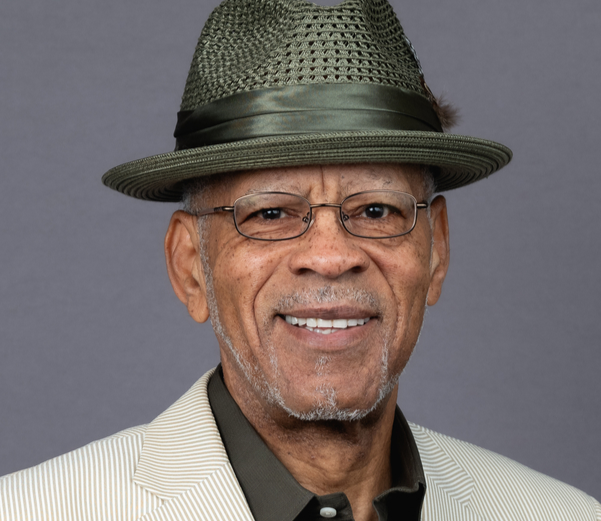
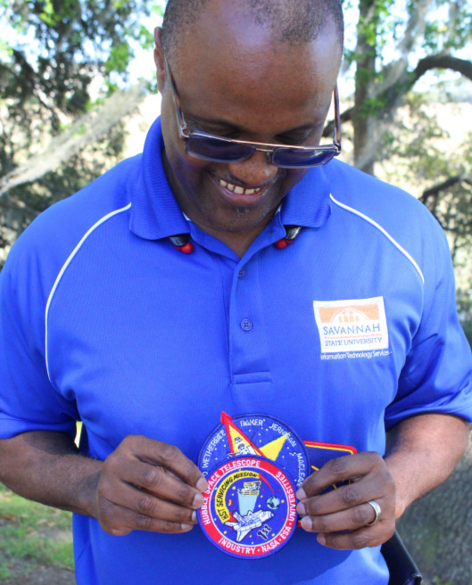
Posted By: Hija Chang on May 18, 2017 FEATURED Content Almost anyone on the Savannah State campus these days will recognize Carl Sneed. He is the guy with a mesh fishing hat and a big grin. One reason for the eternal smile is that Sneed returned to SSU after a trip around the solar system – at least via his work. A Savannah native, Sneed was always tinkering as a child. He recalls his father, a car mechanic, saying he was “sure that boy is gonna blow himself up one day.” One day in 10th grade, Sneed walked into a library and saw a book about radios. He knew then he was going to study electrical engineering. Sneed graduated from Savannah State in 1983 (his senior project for Dr. Raymond Schleuter was a calculator with a circuit board he built himself) and started working at General Dynamics. He tested software for avionics systems that were being fitted into F-16 and F-111 planes. Sneed’s job was to make sure the fire control and the storage management systems integrated with the main computer by writing situations within the software. “You need a creative mind to figure out how to break it,” he laughs. “And then fix it.” Sneed eventually took a position at Unisys, a contractor for NASA’s Johnson Space Center and he became attached to the astronaut simulation team. He wrote software at night to create simulation scenarios that the astronauts would then come in the next morning and use to train for real-life situations on the space shuttle. “There, I specifically worked with the communications system, the KU band which is a special frequency, and on payload interrogators,” Sneed says. “And I simulated various anomalies so they could practice deploying satellites and doing experiments. It was a lot of fun and there was serious camaraderie. It’s amazing what happens when curious minds get together.” After a couple of other posts in the Clear Lake area (the local joke is you don’t change jobs, just badges), Sneed landed a job working on the new Hubble Space Telescope. He contributed to the model systems, the silicon graphics computer, the flight computers and worked on the mechanical engineering. Not long after being deployed, Hubble experienced an issue with one of the mirrors. NASA had just spent millions of dollars designing and building the telescope and if this mirror couldn’t be fixed in mid-space it would all be lost. Sneed helped write software that corrected the mirror and received a special commendation for his efforts. “That right there, is probably what I am most proud of.” https://ssuimpressions.wordpress.com/ If you enjoyed this article, Join HBCU CONNECT today for similar content and opportunities via email! |
 |
Hija Chang
Management, See Moss Interactive Central State University class of 2021 Member Since January 2011 |
Comments
More From This Author
Latest News
 |
How Animation Techniques Are Evolving in 2D Game DevelopmentThe gaming industry continues to evolve, but one thing remains clear—2D games are far from outdated. From indie hits and mobile games to educational apps and platformers, 2D titles continue to attract ...more
alexis morgan • 28 Views • August 6th, 2026 |


Popular News



 |
North Carolina HBCU Unity DayShaw University - Elizabeth City State University - Johnson C. Smith University - Fayetteville State University - Livingstone College - North Carolina A&T State University - North Carolina Central Uni ...more
Reginald Culpepper • 113,210 Views • August 8th, 2016 |


