





Tuskegee researchers develop greener, plant-based fertilizing system
|
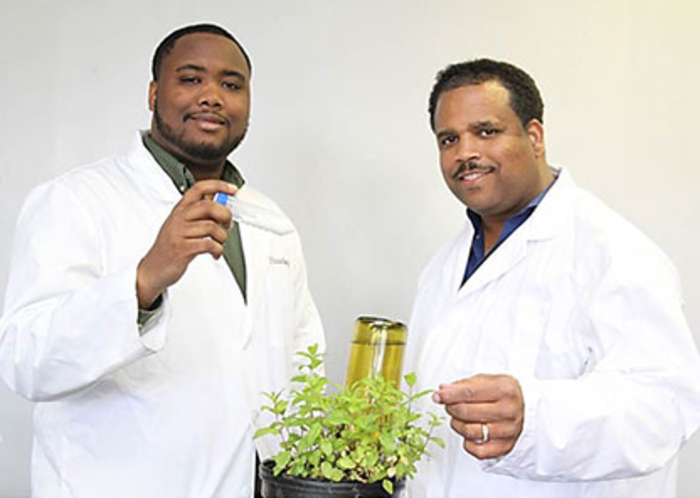
Posted By: How May I Help You NC on April 19, 2018 Contact: Michael Tullier, APR, Office of Communications, Public Relations and Marketing Dr. Michael L. Curry and chemistry graduate student Demetrius Finley Finley and Curry demonstrate experiment. Soon, that next scoop of fertilizer you spread in your garden could be a new, more sustainable option developed by researchers at Tuskegee University. Dr. Michael L. Curry and chemistry graduate student Demetrius Finley have created a new means of delivering nutrients to plants that promises to be more effective, ecological and less expensive than conventional products used by farmers and amateur green-thumbs alike. Instead of combining fertilizing nutrients with chemicals that may prove to be toxic to the ecosystem, the Tuskegee-developed system relies on recycling plant waste – which is in abundant supply. Curry and Finley’s delivery system relies on maximizing the use of cellulose extracted from plant biomass – plant refuse left over from agricultural harvesting and processing that may have otherwise been discarded. This specific type of nanotechnology employs nanocellulose to offer farmers a more efficient and targeted way to feed their crops and increase plant production. “Think of it as plants feeding plants,” said Curry, who is an associate professor of chemistry and materials science and engineering. “This delivery system relies on using parts of one plant to actually nurture the needs of another plant. In addition to boosting agricultural efficiency, this delivery system promises to be one of the most cost-effective means for farmers to sustain and maximize their crop productivity.” Explosive growth in global population levels has forced the agricultural sector to see novel strategies to increase crop productivity, satisfy nutritional needs and achieve food security for billions of people worldwide. In fact, according to the American Association for the Advancement of Science, rising malnutrition and undernutrition due to the insufficient intake of vitamins and minerals have stimulated interest in developing farming systems capable of delivering safe, nutritious and sustainable food supplies to the global community at large. “Nanotechnology has enhanced farming across the world, but there still is an increasing need to target crops with species-specific nutrients,” he said. “On other words, our delivery system, through precision agriculture, is versatile enough to deliver the specific nutrient or nutrients required — such as nitrogen, copper or zinc — to the specific plant in the desired quantities.” Although currently available chemical-based commercial fertilizers and nutrient delivery systems help farmers increase crop yields and enhance profit margins, they come with drawbacks as well. Chief among those is how these conventional fertilizers could destabilize soils due to their toxicity, thereby adversely affecting the environment. “Because our delivery system is composed solely of plant biomass-based cellulose and the nutrients needed by the plant, it presents no ecological detriment to the environment,” Curry said. “It degrades without the release of toxins that can leach into the soil, water supplies and the plants themselves.” Along with patenting their research, Curry and Findley are moving their discovery from the lab to the field for further testing. Along with Tuskegee University colleagues Dr. Willard Collier, an assistant professor of chemistry, and Dr. Richard Whittington, an assistant professor of biology, Curry has partnered with Dr. Jason White, vice director of the Connecticut Agricultural Experiment Station, and Dr. Kimberly Cook-Chenault, associate professor of mechanical and aerospace engineering at Rutgers University, to further optimize and explore the advantages of the newly designed nutrient delivery system. Curry hopes from there that the Tuskegee team will explore opportunities to bring this technology to the marketplace in the next 12 months. © 2018, Tuskegee University https://www.tuskegee.edu/ If you enjoyed this article, Join HBCU CONNECT today for similar content and opportunities via email! |
 |
How May I Help You NC
Management, See Moss Interactive Bellarmine University class of 2021 Member Since January 2011 |
Comments
More From This Author
Latest News




Popular News



 |
North Carolina HBCU Unity DayShaw University - Elizabeth City State University - Johnson C. Smith University - Fayetteville State University - Livingstone College - North Carolina A&T State University - North Carolina Central Uni ...more
Reginald Culpepper • 106,224 Views • August 8th, 2016 |


