


US Constitution
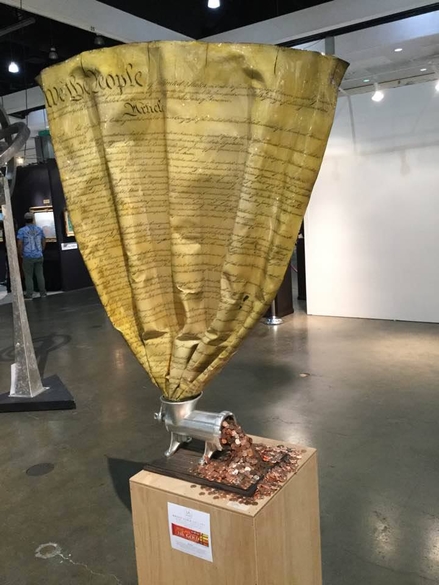
|
Posted By: Victorio Loubriel on January 31, 2020 The GOP has made US Consitution "soiled toilet paper" used by Trump... This document was never really about our race of people. Case and point; We were forced into a "slavocracy" and oppressed by this document ever since.. Ironically, many Americans who are resolutely opposed to racism unwittingly agree with Chief Justice Roger Taney’s claim in Dred Scott v. Sandford (1857) that the Founders’ Constitution regarded blacks as “so far inferior that they had no rights which the white man was bound to respect, and that the African American might justly and lawfully be reduced to slavery for his benefit.” Hummmmmmm!!! In this view, the worst Supreme Court case decision in American history was actually correctly decided. “The argument that the Constitution is racist suffers from one fatal flaw: the concept of race does not exist in the Constitution.” Because our race never existed!!! I’VE BEEN ASKED many times, “What is institutional racism and when did it originate?” I generally respond with a litany of facts about Black unemployment (twice that of whites), housing discrimination (redlining and higher mortgage costs), Jim Crow-type de facto segregation (public education is worst in African-American communities), military and job discrimination (skilled jobs and tech openings). Yet my answer is still incomplete. The source of institutional racism is rooted in the U.S. Constitution itself. It is easy to argue that I’m being ahistorical. Look at the progress, even with the zigs and zags. Aren’t African Americans better off, even if their net wealth is only a fraction of white people’s? Let’s look at how institutional racism was consciously incorporated in the language of the Constitution. Original Documents By the late 1700s the slave trade was on the decline, considered immoral by many educated and enlightened politicians in the United States and Europe. Slavery and racism, however, were powerful economic advantages for increasing property owners’ wealth. U.S. capitalist development was built on the enslavement of Africans, benefitting Northern and Southern farmers and traders. While the Constitution never used the words “slavery” or “slaves,” the document did include provisions defending that inhumane institution. Article I, Section 2, Clause 3 allocated Congressional representation based “on the whole Number of free Persons” and “three fifths of all other Persons.” Articles IV and V, and the 12th Amendment (the last added to the Constitution nearly 80 years after the signing of the original document), also addressed the issues of slavery, slave rights and the slave trade without using the words. The Founding Fathers knew that race and racism lay at the economic base of the new country. The decision to give enhanced political power to the slavocracy was based on a common view held by whites that Africans were inferior to European whites. Northern delegates were opposed to chattel slavery, but freely accepted counting slaves as three-fifths of a human to give the slavocracy more representatives in the new Congress. The concepts of federalism and state rights were thus fully tied to slavery, race and racism. States’ Rights for White Supremacy From 1800 to the 1860s and the crushing defeat of the pro-slavery Confederacy, laws adopted by Congress and rulings of the Supreme Court upheld slavery and racial discrimination. The presidents all supported or accepted the racist ideology. President Lincoln and the new Republican Party openly opposed slavery and supported its abolition. Although Lincoln was careful in his words because of white racism in the country, the Radical Republicans were for immediate abolition. There were no civil rights acts adopted before the Civil War. Since then there have been eight laws or amendments to the Constitution for civil rights. Why so many? States could limit or block the laws under the Constitution’s state rights protections — labeled as Federalism. The federal government has mainly accommodated the states. The most important way to allow freedom of choice is the right to vote without restrictions. The United States is the only major bourgeois democratic country that does not have a national voting rights standard. States’ rights protection is the source of that denial. The first post-Civil War civil rights act was the Thirteenth Amendment, which abolished chattel (human) slavery — a great victory for humanity. But it left it up to the states to implement what happens to the freed people. It included the notorious phrase, “Neither slavery nor involuntary servitude, except as a punishment for crime whereof the party shall have been duly convicted, shall exist within the United States, or any place subject to their jurisdiction.” (my emphasis) What happened next was that former slaveholders sought to bring back de facto slavery. They pushed laws that limited freedom. Freed slaves never received land (a major demand). The right to vote was limited. Freed slaves never received a way to sustain themselves on their own. Mass incarceration is an ironic byproduct of the exception phrase in the 13th Amendment. Some 20 percent of Black males today cannot vote because of prison records. Civil Rights Laws The first empowering Civil Rights Act, adopted by Congress in 1866, guaranteed the rights of all citizens to make and enforce contracts and to purchase, sell or lease property. The 14th Amendment was adopted by Congress in 1868 and ratified by the states in 1870. It was written to include and protect the rights of freed slaves. It declared that all persons born or naturalized in the U.S. were citizens, and that any state that denied or abridged the voting right of males over the age of 21 would be subject to proportional reductions in its representation in the U.S. House of Representatives. The 15th Amendment was adopted in 1869. It forbade any state to deprive a citizen of his vote because of race, color, or previous condition of servitude. The Reconstruction Civil Rights Acts were adopted in 1870, 1871 (two) and 1875 to enforce the new amendments that nullified sections of the original Constitution. Among other things, these acts placed all elections in both the North and South under federal control; barred discrimination in public accommodations and on public conveyances on land and water; prohibited exclusion of African Americans from jury duty; and banned discrimination in voter registration on the basis of race, color, or previous condition of servitude. They established penalties for interfering with a person’s right to vote. That gave federal courts the power to enforce the act and to employ the use of federal marshals and the army to uphold it. From Counterrevolution to Modern Civil Rights The counterrevolution began soon after federal troops left the South. It included using extralegal terrorist groups like the Ku Klux Klan to successfully end the possibility of Black equality. By the late 1880s, the door was shut. Southern states passed “Black Codes” to deny Black rights and dignity, later codified as Jim Crow segregation laws. It took 75 years to get the next Civil Rights Act in 1957. Seven years later President Johnson signed the 1964 Civil Rights Act. It came after the March on Washington in 1963 and the growing power of the movement. In 1965 the modern Voting Rights Act was adopted with teeth. In 1968 a law against housing discrimination was adopted by Congress. Blacks began to shift from the Republican Party in the 1960s. Those who could vote had once identified with Lincoln’s party, not the pro-segregation Democrats. The alliance between northern Democrats and southern Dixiecrats kept the issue of civil rights off the agenda, until the power of the civil rights movement in the 1950s and 1960s forced a shift by the Democratic Party leadership who saw urban Blacks as a new voting bloc. It led African Americans in droves to join the Democratic Party — thousands are now elected officials — and white southerners to leave and change the corporate Republican Party in the 1970s. Key Lessons What does this history explain about institutional racism and the role of the U.S. Constitution? Race was key in all decisions by the ruling class (liberals and conservatives) — that is, to maintain white supremacy and Black inferiority. Although amendments are possible that remove or mitigate the worst features of the Constitution, those amendments can be nullified in practice, and the original language still remains. It’s time to review the power of states over basic human rights that affect every citizen and resident. Voting and civil rights should be based on common standards nationwide, where states can make them stronger but never weaker. Fundamental change requires extralegal mass action directed at the institutions and governing parties of the state. The U.S. Constitution is where institutional racism was encoded from its origins. It’s time to tell the truth and stop the uncritical celebration that rationalizes the glacial — and always reversible — march toward equality. If you enjoyed this article, Join HBCU CONNECT today for similar content and opportunities via email! |
Comments
More From This Author
Latest Blogs
 |
Built to Last: Why a Metal Roof Might Be the Smartest Money You Spend on Your HomeFor a lot of us, buying a home is the biggest wealth-building move we will ever make. We save for years, we navigate the mortgage maze, and we finally get the keys. Then, somewhere between the housewa ...more
boyce fane • 52 Views • October 26th, 2026 |
 |
Built to Last: Why a Metal Roof Might Be the Smartest Money You Spend on Your HomeFor a lot of us, buying a home is the biggest wealth-building move we will ever make. We save for years, we navigate the mortgage maze, and we finally get the keys. Then, somewhere between the housewa ...more
boyce fane • 41 Views • October 26th, 2026 |
 |
Nasha Mukti Kendra in Ghaziabad – A Step Towards a Healthier LifeDrug and alcohol addiction can affect a person's health, family relationships, career, and overall quality of life. Overcoming addiction can be challenging, but with the right support, professional gu ...more
Ragana Cremsoin • 70 Views • October 26th, 2026 |
 |
The hidden dangers of chronic stress and how to protect your healthA professional on a laptop, working under chronic stress.
Stress is a normal part of life. People experience it when facing work pressures, financial difficulties, family responsibilities, healt ...more
Joel Savage • 74 Views • October 26th, 2026 |
 |
How early detection saves lives: The importance of regular health screeningA healthcare professional discusses preventive health screening results with an adult patient to support early detection, prevention, and long-term wellness.
Health is one of life's greatest assets ...more
Joel Savage • 70 Views • October 26th, 2026 |
Popular Blogs
 |
Divorce in America in 2009 – What’s love got to do, got to do with it?
Join Brother Marcus and the cast and the crew of the Brother Marcus Show live this Sunday evening on February 1, 2009 @ 8:00 p.m. for another hot topic in our community! “Divorce in America in 2009 ...more
Brother Marcus! • 75,714,803 Views • January 27th, 2009 |
 |
VISINE ALERT!!!Seemingly innocent medication such as Visine eyedrops are used by people to concoct a mixture with similar effects as a date-rape drug.
When mixed with alcohol and taken orally, the eyedrops can l ...more
Siebra Muhammad • 122,847 Views • May 23rd, 2009 |
 |
"Chain Hang Low" check out the real meaning of the Lyrics!Recently there is a new artist out of Saint Louis that goes by the name JIBBS. Jibbs debut single "Chain hang low" has a history that most people are not aware of. The particular nursery rhyme that th ...more
Tyhesha Judge-Fogle • 81,878 Views • November 9th, 2006 |
 |
HBCU Marketplace Gifts: Divine 9 Premium Fraternity / Sorority Playing CardsVendor: Charles Jones
Item Price: $20.00
Price Includes Shipping: Yes - Shipping Included
Item Description:
Pantheon Series - Divine 9 - Premium Playing Cards (choose Gold Series or Silve ...more
Hija Chang • 64,864 Views • December 2nd, 2018 |
 |
Black College Student Sentenced to 12 Years in Prison for Kissing a White GirlAlbert N. Wilson, a former University of Kansas student, has been sentenced to 12 years in prison and a lifetime of probation after being convicted by an all-white jury of raping a white teen girl. Bu ...more
Roger Gates • 57,582 Views • June 4th, 2020 |


