



HBCU Grad From North Carolina A&T University Makes History Studying Planets in Outerspace
|
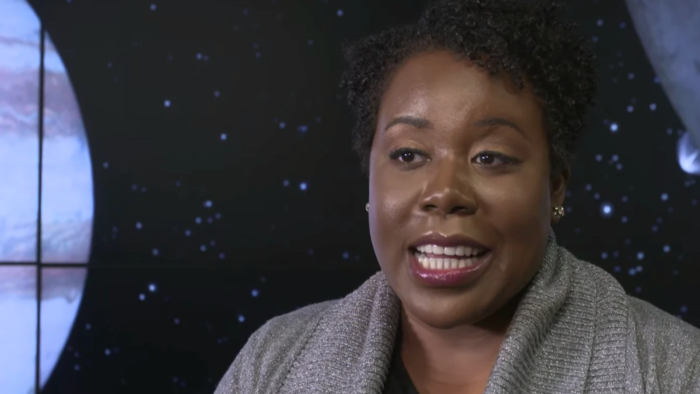
Posted By: Will Moss on July 22, 2020 Planetary geophysicist Lynnae Quick has dedicated her career to investigating the inner workings of planets and moons. Today, she is the Ocean Worlds Planetary Scientist at NASA Goddard Space Flight Center. Unlike her colleagues studying Earth, Quick can’t just jet off to investigate these faraway locales for her research. Instead, she combines satellite data, an understanding of Earthly geological processes, and the power of mathematics to imagine — and model — how other worlds might behave. Her research has taken her from volcanic plumes on Jupiter’s icy moon Europa to the surface of the crater-laden dwarf planet Ceres and possible ocean worlds outside the bounds of our solar system. Mentors helped her find her way to icy moons Quick grew up in Greensboro, North Carolina and found her way to the sciences through a high school biology course. She considered becoming a zoologist or a physician, until she learned about the death of stars and the creation of supermassive black holes in her physics class. Her teacher, John Brown, nurtured Quick’s curiosity for the cosmos and encouraged her to pursue a career in the space sciences. Mentors like Brown played an instrumental role throughout Quick’s career. She pursued a degree in physics at North Carolina A&T University, a historically Black college or university (HBCU). She credits attending an HBCU with instilling confidence in herself and her potential as a Black woman in the sciences. “I was used to seeing bright African American students being taught by African American teachers,” she says. “That helped me become confident in a way that might not be the case for people who were always the only person of color everywhere they went.” After graduating, Quick got a master’s in physics from Catholic University of America in Washington, DC. There, her interests gravitated towards volcanic activity on planets and moons. She discovered the work of Brazilian planetary geologist Rosaly Lopes, who studied Jupiter’s moon Io (the most volcanically active body in our solar system with hundreds of volcanoes — some of which spew fountains of lava 250 miles high). “I contacted her and basically said: I think your work is really cool!” Quick said, “For me, it was easier to cold email her because I saw her as another woman of color who was inside the sciences.” Lopes recommended Quick get in touch with her colleagues Louise Prockter in Washington, DC. Through that connection, Quick began working with Prockter at the Johns Hopkins University Applied Physics Lab (APL), where she studied chaos terrain — planetary surfaces marked by ridges, cracks, and plains that become intertwined and entangled in one another as a result of geologic activity — on Jupiter’s moon Europa. Poring over maps of Europa’s surface, Quick became fascinated with the inner workings of the icy moon and the geological processes that carved out these chaotic topographies. She later told NASA, “I felt there was a whole other alien world at my fingertips.” “The mission chose me” Quick followed her fascination with Europa to a doctoral program at Johns Hopkins University, where she continued working with Prockter and faculty advisor Bruce Marsh. Prockter reflects, “I have always been impressed by Lynnae’s clear-sighted vision of what she wants, and her willingness to take some significant leaps of faith in order to realize her goals.” There, she was drawn in by spectacular geyser-like plumes of water vapor erupting from cracks in the surface of Saturn’s moon Enceladus. She began to wonder, “Why don’t we see these plumes erupting from Europa?” Both Europa and Enceladus have surfaces covered by ice. Both have a subsurface ocean. And Europa should have more water because of its larger size. Europa’s larger size and higher gravity, however, could create smaller plumes that might be missed by a spacecraft camera. Set on plume spotting, Quick devised new modes of detection that would enable a camera to find Europa’s putative plumes. This work caught the attention of Elizabeth “Zibi” Turtle, a planetary scientist at APL, who wanted to develop a camera to outfit NASA’s upcoming Europa Clipper mission. Set to launch in 2024, the mission would be the first detailed study of Europa. Turtle invited Quick to collaborate, and NASA ultimately selected them to lead the mission’s Europa Imaging System. Geysers erupting on the surface of Enceladus, photographed by Cassini NASA “The mission chose me,” Quick recalls. “Serving on a mission where we’re sending a spacecraft out to Europa is just out of this world for me — no pun intended!” Paying it forward The Europa Clipper mission was the first of many missions Quick has joined. Most recently, Quick joined the Dragonfly mission, which will venture to Saturn’s largest moon Titan. The spacecraft will explore the carbon-rich moon through a series of controlled flights,taking off and touching down to analyze the ocean world’s chemistry for hints of habitability and how life may have arisen here on Earth. She serves as the lead for Dragonfly’s Student and Early Career Investigators Program, which gives undergraduates from diverse backgrounds the opportunity to work on the mission. Quick is committed to fostering a more diverse workforce for the future to advance the field. “People who are minorities tend to think really outside of the box,” Quick notes. “I wonder how much of that creativity we are missing in our field because it is so homogeneous?” Outside the box thinking is a necessity for scientists who are underrepresented in their fields — not only to advance their research, but also to imagine and carve out spaces for themselves to thrive. “We often have to make ways out of no way,” she adds. “We don’t always have the privileges that other groups have, but we still have to find ways to be successful.” Lynnae Quick giving a presentation at University of Maryland-College Park According to the African American Women in Physics database, Quick is only the second African American woman to receive her doctorate in planetary sciences. But she’s often asked to talk only about her journey as a woman in science, rather than her experiences as aBlack woman or woman of color in science. “We not only deal with sexism. We also have to deal with racism,” she notes. “We need to think of diversity on multiple axes.” Embracing and openly discussing all of her identities has made Quick a powerful mentor. One of her mentees, astrochemist and #BlackInAstro organizer Ashley Walker, reflects, “Lynnae has helped me in so many different ways. It’s very comforting knowing that someone that looks like me will always be in my corner.” Creative writing Throughout her career, Quick has nurtured her own creativity — while also relieving stress — by embracing the arts and humanities. In college, she took creative writing classes, where she wrote historical romance stories that centered on Black characters. Writing allowed her to both hone her communication skills, while giving her a new outlet to exercise her mind. “You have to connect plot points and there has to be a conclusion to the story, in much the same way as we’re trying to connect dots in science all the time.” Constructing these fictional worlds also instilled a sense of confidence in her ability to hypothesize about the real worlds beyond our own. “To a certain extent, creative writing made me trust my own ideas and not think they were too crazy or wacky or strange to consider.” She didn’t always want to be a scientist Despite her success and deep dedication to planetary sciences, Quick was not always interested in science. As a geophysicist, she’s often asked to bring in photos of her playing with rocks as a child — a sign of her early passion for science. But she spent most of her childhood playing with Barbies. “We want to remember that not all kids who grow up to be scientists — and not all women who grow up to be scientists — follow the same path,” she says. “It takes all types.” In fourth or fifth grade, she recalls her frustration at an assignment to learn the names and the order of the planets in our solar system. She remembers complaining to her mom, “When am I ever going to need this in my life?” Now, she confesses, “I guess the joke was on me!” If you enjoyed this article, Join HBCU CONNECT today for similar content and opportunities via email! |
 |
Will Moss
Founder & CEO, HBCU CONNECT, LLC Hampton University class of 1995 Member Since June 1999 |
Comments
More From This Author
Latest News





Popular News



 |
North Carolina HBCU Unity DayShaw University - Elizabeth City State University - Johnson C. Smith University - Fayetteville State University - Livingstone College - North Carolina A&T State University - North Carolina Central Uni ...more
Reginald Culpepper • 105,794 Views • August 8th, 2016 |


