





Wayne National Forest Hosts Lincoln University Students Through Cultural Heritage in the Forest Program
|
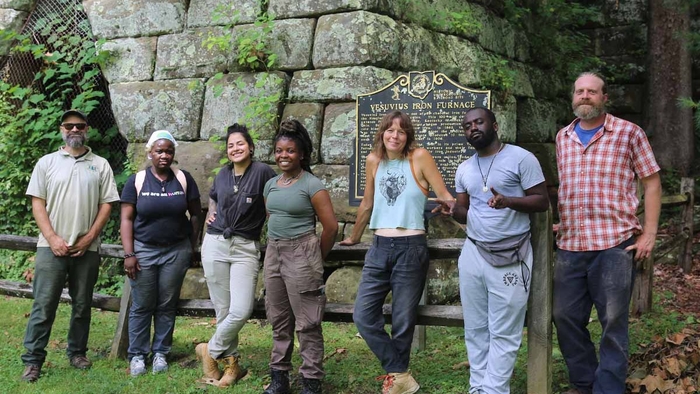
Posted By: Kennedy Williams on October 05, 2022 This summer, the Wayne National Forest hosted a group of anthropology students from Lincoln University, a Historically Black College in southeast Pennsylvania. The visit was part of the new Cultural Heritage in the Forest program, which was developed by the Advisory Council on Historic Preservation (ACHP) and the USDA Forest Service’s Heritage Program. The program’s goal is to introduce young professionals from diverse backgrounds to careers in conservation, historic preservation, and cultural resource management. The student envoy included Mikayla McCray, a Political Science major who is also studying for minors in International Relations, Sociology, and Anthropology; Julian Murray, a senior majoring in Human Services; Nelida Ornelas-Rosales, a junior studying Sociology, Anthropology, and Spanish; and Xhavé Zaire-Jackson, a recent graduate who majored in Anthropology, Criminal Justice, and Forensic Science and minored in Mass Communications. Their faculty advisor, Melina McConatha, teaches Psychology and Human Services. The group also comprised representatives from the Forest Service’s Eastern Region Heritage Program, including Regional Architectural Historian Paden Vargo, Regional Architectural Historian Patrick Raley, and Monongahela National Forest Heritage Program Manager Gavin Hale. They were greeted by Andy Tremayne, the Wayne National Forest’s Heritage Program Manager, who led the tour by showing the group several relevant historic sites on the forest. They first visited the Vesuvius Dam on the Ironton Ranger District. Constructed in the 1940s, the dam is approximately 35 feet tall and is made up of a concrete base covered by an earthen exterior. The group then toured a nearby cabin that was once used as the original Ironton District Ranger Station. Though it is currently not in use, Forest Service architectural historians are interested in renovating the cabin for use as a visitor rental or employee guest quarters. Modern visitors to the area may not know that both the Vesuvius Dam and the old ranger station cabin were built by Civilian Conservation Corps Regiment 526C, which served on the Wayne National Forest from 1936 to 1942. The “C” in the 526C unit designation is an infamous reminder of past injustices; it stood for “colored,” indicating that it was composed of Black members. “The regiments of the Civilian Conservation Corps, which were responsible for building much of the Forest Service’s infrastructure, were at first integrated,” explained Vargo. “But sadly, they were later segregated after some units – primarily from the South – complained. Today it’s important that we remember and recognize the contributions of these diverse CCC regiments. Fewer than 2% of designated historic structures were built by minorities, so we need to be careful to preserve what remains.” The group also met with Ironton District Ranger Mathias Wallace, who shared his own career journey and encouraged the students to consider jobs with public lands. Wallace attended Alabama Agricultural and Mechanical University, also a Historically Black College, and talked with the students about the importance of a welcoming atmosphere for visitors from diverse backgrounds. Wallace also provided the students with information about internship and entry-level programs with the Forest Service, including AmeriCorps, HistoriCorps, Pathways, and the Resource Assistants Program. The tour continued with an archaeological survey at a ridgetop site above Lake Vesuvius. Site records are sparse, but it appears to have been a pavilion flanked by two stone chimneys, and it may have been built by Job Corps workers in the 1960s. The group investigated the site, took measurements, and used a metal detector to search the surrounding grounds for artifacts. Using sieves, the students sifted through dirt and found chert, a thin stone chip formed from sharpening a projectile point. The discovery indicated that an American Indian Tribal ancestor had worked to refine a tool at the site location at least 500 years ago. The following day the group visited Poke Patch, a mid-1800s Free Black settlement near the modern-day border junction of Lawrence, Jackson, and Gallia Counties. Once part of the Underground Railroad, the community was a sanctuary for those seeking freedom in Ohio from the cruelty and injustice of slavery. Poke Patch was home to both farmers and iron workers employed at the nearby Cambria Furnace. Fired by coal, the massive furnace stack once produced 12 tons of unrefined iron per day with ores mined from surrounding lands. Overgrown and long since abandoned, Poke Patch and Cambria Furnace are now part of the Ironton Ranger District and are slowly being reclaimed by the forest. After touring the sites, the group talked about what life was like for the residents and discussed ways to map, preserve, and clear vegetation from the sites. The visit concluded with a trip to Serpent Mound, a National Historic Landmark managed by the Ohio History Connection in nearby Adams County. The world-renowned site was constructed by ancient American Indian cultures of Ohio and depicts an earthwork shaped like an enormous snake with a coiled tail. “I am grateful for the opportunity to share this lesser-known history of the Wayne National Forest that includes the role that minorities and underserved populations played in this region,” stated Tremayne. “From the Free Black community of Poke Patch, which served as a route for the Underground Railroad, to the construction of Vesuvius Dam and recreation area in 1940s by the all-Black Civilian Conservation Corp regiment, these stories need to be told, and students and citizens of all backgrounds need know they are welcome on our public lands and there is a place for them in the Forest Service and here in southeast Ohio.” SOURCE Lincoln University If you enjoyed this article, Join HBCU CONNECT today for similar content and opportunities via email! |
 |
Kennedy Williams
From Loganville, GA Spelman College class of 2020 Member Since July 2016 |
Comments
More From This Author
Latest News





Popular News



 |
North Carolina HBCU Unity DayShaw University - Elizabeth City State University - Johnson C. Smith University - Fayetteville State University - Livingstone College - North Carolina A&T State University - North Carolina Central Uni ...more
Reginald Culpepper • 105,544 Views • August 8th, 2016 |


