






‘This is a calling’: Two HBCUs in the nation’s Capital get New Presidents
|
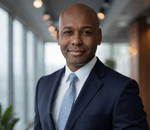
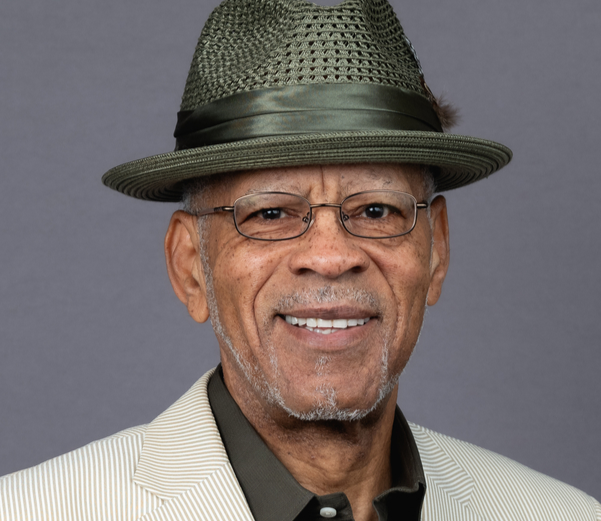
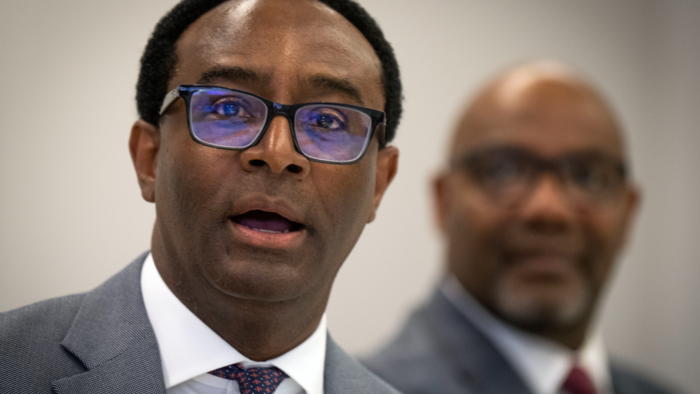
Posted By: S. Moore on August 14, 2023 Two 53-year-old academic leaders are taking the helm this summer at the two historically Black universities in the nation’s capital. One is a newcomer to the world of HBCUs, the other a product of them. Ben Vinson III, who starts Sept. 1 as president of Howard University, and Maurice Edington, who took office Aug. 1 as president of the University of the District of Columbia, spoke with The Washington Post last week about goals and challenges ahead. Vinson, a historian, was previously provost at Case Western Reserve University in Ohio, while Edington, a chemist, was executive vice president and chief operating officer at Florida A&M University. Howard, with about 12,900 students last fall, is a private and well-known research institution that receives a special appropriation every year from Congress. UDC had about 3,600 students in 2022 and is a public university with a community college, law school and graduate programs. Elsewhere in the city, Ellen M. Granberg started July 1 as president of George Washington University, and Peter K. Kilpatrick started last year as president of Catholic University. This interview was edited and condensed for clarity. Q: What’s uppermost in your mind for your schools as you’re starting? Vinson: All of us have been recognizing over the past several years an overall declining faith in the value of higher education. It’s been under scrutiny. And so this is a time for all of our institutions to really rise to the moment. What that looks like is going to look quite different in every particular institution. And so, making the case for differentiation, value, really polishing what an education means in this age, with the transformation of the student body that has been taking place, the covid impacts on our students — these are the kinds of questions that are certainly on my mind as I’m coming in. Edington: What’s been driving my thoughts every day is really a passion and being aggressive about the blueprint that we’re going to follow at UDC. We’re finalizing the development of our new strategic plan. So every day I’ve been thinking, okay, we’ve got to really focus, get everybody on the same page about finishing that. Q: What do you see as key strengths of your institutions right now? Edington: For me, that’s an easy one. It’s the people and their commitment to the institution. These people are very committed and passionate about the mission and serving the students. That drew me into UDC because I felt that with that commitment, that was something we can build off of. If you don’t have that, it’s kind of hard to move forward. Vinson: You have commitment from upper leadership down into the lowest levels of our staff, all focused on the educational mission of our students. Two other things have really resonated. At Howard University, research is on fire. There’s so much talent in the faculty ranks, so much strength in the various disciplines. It’s on the brink of even further greatness. Q: What are a couple of key things you want people to know about you? Vinson: This is more than a job for me. This is a calling. You are really involved in transforming lives in a profound way, and you’re connected with a deep legacy and mission that for hundreds of years has been about equity and access and uplift. As Howard, as UDC, as GW, Catholic go — those have reverberations on our city. The university ecosystem can contribute greatly to a city’s success and stature. Howard University names scholar of the African diaspora as its new president Edington: My prior institution, I’d been there 25 years. I knew that place top to bottom. At Florida A&M, I had a good situation. But I felt there was something missing, in the sense that I felt I had given all I could give to move that institution forward. So I started wanting to seek out a place that aligned with where I was at in my career, where I can contribute, impact lives and make a difference. I want to serve the District and be seen as a person who really ensures that UDC is a strong community partner. Q: What can UDC do to serve more students? Enrollment has been down in the last decade. It used to be more than 5,000. Edington: It starts with increasing awareness across the District, in the K-12 system, in the homes of students and their parents, about what we have to offer. One of the things that struck me through the interview process, I told several people: “You know what? You all are a hidden secret.” I live in the HBCU community. I’m very familiar with the institutions. But I was not fully aware of all of the great things that this institution has. We are very unique because we have pathways at every level: a certificate, an AA degree, a bachelor’s degree, a doctoral degree, a JD. We have to make sure the community is aware not just that we have them, but that those are pathways to success. And then, [we have to] continue to retool what we do internally, get better at the things that need improvement. There’s no magic. It’s a bricks-and-mortar approach. Q: More students are graduating from high school, more students are going to college, but not as many are finishing. How are you looking at retention, making sure kids actually get through and graduate? Vinson: It is imperative to make sure we are committed to retention, committed to helping make sure that our students get through. Sometimes it’s not always the academics, but it’s the wraparound support, it’s financial aid. It’s making sure that course holds are not interrupting them from progressing in their career path. Edington: It’s something I’m personally very passionate about. At my prior institution, we were one of 12 institutions in the state university system. We were each evaluated annually with respect to student success metrics, retention rates, four-year graduation rates, employment outcomes. That experience taught me a lot of useful lessons and best practices. So I’m bringing that to UDC. We’re going to have a strong focus on outcomes because every student that we accept, we have to be strongly committed to that student’s success and helping our students get to the destination that they had in mind. Q: Can you give an example of one strategy that worked well? Edington: One is predictive analytics. You think about trying to understand what makes a successful student. Data can help you figure that out. Each comes to the institution with a set of experiences. Certain indicators we can use to understand what the student is strong in, and where they need help, where are their weaknesses. Then we use that information to build an academic plan based on the data that we’ve analyzed. The other is the concept of “intrusive advising.” I’m monitoring things like your quiz grades, your class attendance, comments from your professors. And we are trying to connect with that student before they fall too far behind. Vinson: Interlocking communication between all of those who are touching our students. Making sure the academic elements are connected with the social elements. So that there’s a full-team approach to student development. Q: With the recent Supreme Court decision that rejected race-conscious admissions, what impact do you think that could have on your campuses? Vinson: I’m not sure. It’s still early, to be honest. The Biden administration is working on guidance. You can expect full cooperation from our institutions on whatever comes from the administration. At the end of the day, we’ve always been about equitable access to education. We want to make sure that students have a choice, that if they want to come to us, that they can come. Q: Dr. Edington, you have deep experience in the HBCU world and you went to Fisk University, a historically Black school in Tennessee. Dr. Vinson, you’re coming new into the HBCU world here. Could each of you talk about that now as HBCU leaders here in the District? Vinson: For me, obviously, part of my first year is going to be really learning the culture and understanding the HBCU environment and universe. I’m delighted to be coming into this role. When I think of Howard University, I think of one of the great institutions of higher learning, period. It is an HBCU, yes, but it’s also a great institution. I want to fully embrace everything it means to be part of an HBCU and to really champion that culture. I come from a different background. But the freshmen that just arrived on our campus have never been to an HBCU. Q: So you’ll be learning along with them. Vinson: I’m in my freshman year. I’m nervous, I’m giddy and excited. I’ve got to move in myself. Edington: HBCUs saved my life. I’m from a very impoverished background, and I wouldn’t be here today, probably wouldn’t be alive, I’ve always felt, if I had not found my way to Fisk University. I stepped on the campus with no idea what I was getting into, no real training on how to be successful. Those people at Fisk wrapped their arms around me, put me on the right path. As you can see, I stayed at Florida A&M for 25 years doing that good work. And what made me want to come to UDC was an opportunity to continue it and have a greater impact. I figured I could be a good role model for students and show them an example of what you could become with the right support. That HBCU fiber is part of my fiber. SOURCE The Washington Post If you enjoyed this article, Join HBCU CONNECT today for similar content and opportunities via email! |
Comments
More From This Author
Latest News

 |
Rosen Foundation expanding scholarship program, partnering with Bethune-Cookman UniversityCarrying on the legacy of Harris Rosen and his commitment to education, today the Harris Rosen Foundation announced it is expanding its already-successful scholarship program and partnering with Bethu ...more
Reginald Culpepper • 301 Views • May 19th, 2026 |
 |
Sinners vs. Michael: Which Film Actually Won the Ultimate Culture Debate?While Antoine Fuqua’s Michael is dominating the box office with its electrifying, stadium-level concert recreations and a star-making, uncanny physical performance by Jaafar Jackson, critics and film ...more
TaQuan Ford • 234 Views • May 16th, 2026 |
Popular News



 |
North Carolina HBCU Unity DayShaw University - Elizabeth City State University - Johnson C. Smith University - Fayetteville State University - Livingstone College - North Carolina A&T State University - North Carolina Central Uni ...more
Reginald Culpepper • 109,468 Views • August 8th, 2016 |


