


Central State University researchers lead $10 million USDA-funded sustainable agriculture systems project
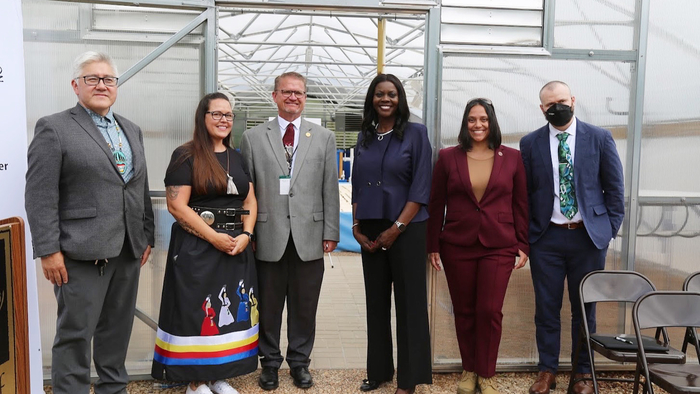
|
Posted By: Reginald Culpepper on September 01, 2023 Starting in late 2021, Brandy Phipps, Ph.D., Central State University assistant professor in the Department of Agricultural and Life Sciences and a researcher in the Food, Nutrition, and Health project of the Agriculture Research and Development Program, has been director of the Sustainable Use of a Safe Hemp Ingredient (SUSHI) project. The central mission of the five-year SUSHI project is to investigate the use of hemp as an aquaculture feed, training aquaculture producers, and increasing the production of healthy fish in the Menominee Nation. Aquaculture is also known as “acquafarming,” or the controlled production of aquatic organisms such as fish or algae. Phipps initially wrote the grant that has been funding the SUSHI project through the United States Department of Agriculture (USDA), the federal governmental agency that oversees farming, ranching, and forestry industries. The USDA is responsible for safety in food quality, regulation, and nutrition labeling. The National Institute of Food and Agriculture (NIFA) — which provides leadership and funding for programs that advance agriculture-related sciences — also provides funding for SUSHI. Working under the auspices of the John W. Garland College of Engineering, Science, Technology, and Agriculture, Phipps’ more specific goal in relationship to the Central State community is to leverage SUSHI as a means to help bolster diversity in the agricultural workforce, which has historically been lacking. Projects such as SUSHI, Phipps strongly believes, can aid in alleviating such crucial statistical gaps by collaborating with communities — particularly members of the underserved and underrepresented — to generate substantial agricultural development and outreach programs that will ultimately lead not only to further workforce equity but independent community food sovereignty, as well. Such partnerships in Phipps’ SUSHI investigations include College of Menominee Nation, University of Delaware, Kentucky State University, University of Kentucky, and Mississippi State University. In Phipps’ words, agriculture is, by nature, a “food system.” This means those working within the field are in essence “dealing with people. People on the production side of the value chain. People on the consumption side of the value chain. And there are factors for both to be productive, healthy, and economically secure.” Between all these vital issues within the agricultural food system, there’s “everything in between,” Phipps said. This includes soil health and water health. If someone within the system wants to, for example, grow a new crop, this will take acreage away from another crop that already exists. An advantage here is the diversification of crops. Cons may include those involving economics, environmental, distribution, pollinator, animal, and value chain issues. “Our particular project touches on the entire value chain,” Phipps said. “My background is in biomedical sciences and human nutrition. The larger (thing) I’m thinking about is how to approach this problem of feeding a growing population and solve that problem through agriculture in ways that are economically feasible for everybody along the value chain people producing and people buying the food.” The further and perhaps more critical question for Phipps and her SUSHI team at Central State, then, is how to not only feed people now but also how to feed generations to come in the most economically and environmentally means possible. Phipps is also considering how to do so in a way that will be equitable. “I’m really a ‘systems thinker,’” Phipps continued. “So, the way that I approach problems is from the perspective that they are most often complex, with complex contributing factors. And because they’re complex with lots of different contributing factors, there’s value to these kinds of projects, and they need to happen. “I tend to want to do the projects that are naturally cross-cutting and are multi-disciplinary so that we can find complex solutions to complex problems.” “(Phipps) and I were both still pretty new on campus back in 2019, and it was summer, and she was going around campus getting to know people when she stopped by my office one day and introduced herself,” remembered Central State Research Assistant Professor of Natural Sciences Craig Schluttenhofer, Ph.D. Schluttenhofer and Phipps immediately began talking about the benefits of hemp, particularly those that would be useful for health and medicinal wellness. “It was a great discussion. We immediately began working together,” Schluttenhofer said. “This was when we started talking about the SUSHI project and began getting it worked out.” While Phipps leads the SUSHI project at Central State, Schluttenhofer directs research on campus, which includes working with a lot of Marauders in the lab. Schluttenhofer, who specializes in plant physiology, has a particular interest in growing and leveraging the value of hemp as a viable plant alternative for a variety of practical uses. “There’s been a long misconception in the interchangeable use of terminology between ‘hemp’ and ‘cannabis’ or ‘marijuana,’ as though they’re all the same thing,” Schluttenhofer acknowledges. “So, when people hear ‘hemp,’ they automatically think of the high-THC cannabis that could be intoxicating. But by definition, hemp has to have low levels of THC. The federal limit for hemp is 0.3% THC. We see a lot of potential for hemp, which historically has been used for its grain and for its fiber.” That grain, Schluttenhofer added, can be used for human food consumption. While the hemp grain can go into “a host of problems, though most people traditionally think of rope along with many, many other applications it can be used in.” In fact, some of the drafts of the United States Constitution were written on paper made from hemp. Hemp seed is also very rich in both protein and oil for improved fishmeal, for example. “I’ve worked with students from every college on campus, including those from the business school, agriculture education, and even one student last spring who majors in social work who did some really cool, interesting work for us,” Schluttenhofer said. “She was looking into some hemp-derived intoxicating compounds that are now on the market to understand the social impacts of drugs on communities.” With funding coming from the SUSHI grant, there are several projects Phipps and Schluttenhofer are working on, many of which not only involve but employ and pay students onboard. The projects developed under the SUSHI project are uniquely tailored toward Central State due to the extensive and diverse backgrounds of Phipps, Schluttenhofer, and their cohorts at the school, which include health and nutrition (Phipps), hemp production (Schluttenhofer), and fish expertise and water health via Kumar Nedunuri, Ph.D., professor of Water Resources and Environmental Engineering. Together, the Central State researchers on the SUSHI project are, in effect, able to devise new ways of cultivating alternative plant products from hemp in order to find more sustainable ways of creating feed for animals (especially fish), as well as establishing a more equitable means of nutritional development and sovereignty for humans, especially those in underserved communities. “If we can find new methods, as with hemp cultivation, to help community members in largely land-locked areas like ours to develop new methods of producing their own fish independent of coastal ocean-based fishing,” Schluttenhofer said. “Realistically sustainable long-term fishing in the oceans is being depleted rapidly for various reasons involving those that are both economic and environmental, which is why we want to develop such markets in places elsewhere like where we are. Hopefully, we can make such a significant impact with this project. That’s really what we’re trying to do here with SUSHI.” About Central State University: Central State University is a public HBCU and 1890 Land-Grant Institution with a 136 year tradition of preparing students from diverse backgrounds and experiences for leadership, research, and service. Central State ranks among U.S. News & World Report’s best colleges in five categories, including Best Undergraduate Engineering Program and Top Public Schools. The University fosters academic excellence within a nurturing environment and provides a solid liberal arts foundation and STEM-Ag curriculum leading to professional careers and advanced studies globally. EEO Statement: Central State University, an 1890 Land Grant Institution, is committed to the full inclusion of all people and does not discriminate based on race, age, ancestry, color, disability, gender identity or expression, genetic information, HIV / AIDS states, marital or family status, military status, national origin political beliefs, religion, sex, sexual orientation, or veteran status. If reasonable accommodation is needed, please contact the Department of Human Resources at (937) 376-6540. Affirmative Action/Equal Opportunity institution If you enjoyed this article, Join HBCU CONNECT today for similar content and opportunities via email! |
 |
Reginald Culpepper
President, Fulfillment and Web Services, HBCUCONNECT Clark Atlanta University class of 1998 Member Since September 2000 |
Comments
More From This Author
Latest News




Popular News



 |
North Carolina HBCU Unity DayShaw University - Elizabeth City State University - Johnson C. Smith University - Fayetteville State University - Livingstone College - North Carolina A&T State University - North Carolina Central Uni ...more
Reginald Culpepper • 104,281 Views • August 8th, 2016 |


