






National Science Foundation $400,000 grant will allow Central State University to expand its criminal justice studies program
|
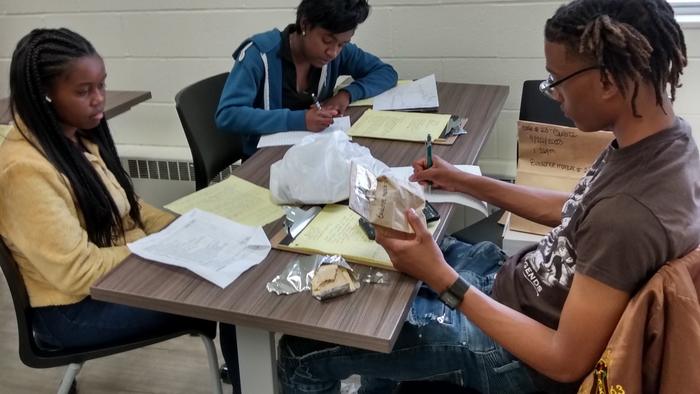
Posted By: Reginald Culpepper on October 03, 2023 The National Science Foundation announced in early September that Central State University has received a substantial grant of approximately $400,000 that will be used over the next three years to support, improve, and expand the Criminal Justice program. Most significantly, the funds will be used to create a Forensics Studies minor as part of the program. Genevieve Ritchie-Ewing, Ph.D., an assistant professor of Sociology and Anthropology at Central State, spearheaded the grant application and will largely guide the Forensics Studies minor development process along with the creation of its classes. After receiving her Bachelor of Science in Biology from Pennsylvania’s Millersville University, Ritchie-Ewing earned her Master of Arts (M.A.) in Anthropology from the University of Tennessee. There, Ritchie-Ewing first learned the forensics trade through the renowned, 50-year-old Anthropological Research Facility (ARF), also known as the Forensic Anthropology Facility. “The Body Farm,” to which it is commonly referred (and popularized by best-selling crime novelist Patricia Cornwell), was the first such facility to focus on the decomposition of human remains in the interest of both anthropological and criminal investigative studies. Upon graduation, Ritchie-Ewing put her newly acquired skills to work as a crime scene technician for the Tennessee Bureau of Investigation. She concurrently worked as an autopsy technician for the Knox County Medical Examiner’s Office. “There were a lot of memorable experiences during that time, though most of them are gross,” Ritchie-Ewing, who has been at Central State for five years and is as such currently up for tenure promotion, laughed during a recent interview. “I was collecting all of the evidence, handling a lot of the crime scene photography and video, and all of that kind of thing. There were some very difficult cases while I was there, it all got to be ‘a lot’ after a while, and I wanted to move on.” Two years after starting in her crime investigative role, Ritchie-Ewing felt the pull back to academia and left to pursue her doctorate degree. Being that her husband (whom she’d met in Tennessee) is an Ohioan who works as a mechanical engineer at Wright-Patterson Air Force Base, Ritchie-Ewing chose Ohio State University for the Ph.D. she completed in 2019. “My focus was on medical anthropology,” Ritchie-Ewing said, distinguishing the field from standard anthropology by the fact that the former “had me looking at living people rather than dead people.” During her last year finishing her dissertation in 2018, Ritchie-Ewing worked as an adjunct professor at Central State and another university. When Central State, interested in her extensive background in forensics, offered her a full-time position as assistant professor, Ritchie-Ewing jumped at the opportunity. “While CSU had a Criminal Justice program, there wasn’t really any forensics in the same area,” Ritchie-Ewing said. “The Chemistry program has a forensics science class, but it focuses on the chemistry side of things. I wanted to focus more on evidence collection and how that works, as well as some of what we’ll be able to do with the National Science Foundation grant to help us look at the social science of forensics.” Ritchie-Ewing is especially passionate about bringing more opportunities for Criminal Justice and Investigative Studies classes to Central State due to its being an HBCU (Historically Black College or University) and the need for diversification in the criminal justice field. It’s similarly Ritchie-Ewing’s determination that her deep knowledge of and professional background in forensics is of great value to Marauders who may be first-generation students and/or have extracurricular challenges that require more intimate tutelage than that which is offered by larger institutions of higher learning. “There’s tons of one-on-one mentoring that goes on here,” Ritchie-Ewing said. “There’s a higher expectation at Central State of taking care of the students and checking in with the students than anywhere else I’ve been.” While Ritchie-Ewing headed up the grant process and will remain PI (principal investigator), she has brought in three other Central State faculty members to assist in ensuring the funds are best utilized. These other three faculty members are: Virginia Paula Redman, Ph.D.; Leanne Petry, Ph.D.; and Suzanne Saleem, Ph.D. “Drs. Petry and Saleem are in the Chemistry program, and we wanted to make sure to loop them in since they do have forensics classics already in there,” Ritchie-Ewing said. “We wanted to make sure we had their support, as well as the fact that both of them have been at Central State a really long time and have been very helpful in navigating the grant process, including things like creating workshops for other faculty.” Redman, meanwhile, was “looped in,” as Ritchie-Ewing continued, due to her being in the Criminal Justice Department, where there are a lot of students who will be interested in these new programs. Redman also has much experience with the Kentucky State Police, which leads to access to many helpful contacts. “The four of us Central State faculty members work really well together here because we all help to pull in different sides of the University,” Ritchie-Ewing said. “And with all of us together, we have here a fully interdisciplinary minor in Forensics Studies with these different classes from all over the school, in addition to the three new courses of forensic psychology, forensic anthropology, and forensic social work.” It’s Ritchie-Ewing’s hope that the work her colleagues and she on the grant are doing will allow students to take part in the new minor and aforementioned classes in development by next fall. “A lot of our students are very excited about the forensic psychology and forensic social work components,” Ritchie-Ewing said. “If forensics is something they want to do, those courses haven’t been offered before, and there’s really nothing else right now they can take to prepare for them. So, this minor will give them a chance to do that.” Ritchie-Ewing is herself very excited about these new courses and minor that will better equip Central State students to go into forensics once they graduate, particularly as she has been receiving many requests from both the FBI and local police forces looking for educated criminal investigators who also have a better understanding of diversity, equity, and inclusion (DEI) and appreciation of cultural differences. As such, students studying the minor will be required to complete a course on DEI that will help students gain that knowledge, understanding, and appreciation. Ritchie-Ewing believes this DEI component to the minor will be unique to Central State, as it is something she hasn’t seen in any other university program. Complementing the classes and minor being created, Ritchie-Ewing and her team are also constructing a new Forensics Studies Laboratory to be housed on campus in the Charles H. Wesley Art & Science Building. “I don’t think our department (sociology) has ever received a grant this large before,” Ritchie-Ewing said. “This will be an unusual opportunity to get high-end equipment for the students and let them see what a real crime laboratory would look like. This will put them on firmer footing for job opportunities in the future. They’ll really come away understanding how this equipment and the growing field of forensics work with all of these new resources.” About Central State University: Central State University is a public HBCU and 1890 Land-Grant Institution with a 135-year tradition of preparing students from diverse backgrounds and experiences for leadership, research, and service. Central State ranks among U.S. News & World Report’s best colleges in five categories, including Best Undergraduate Engineering Program and Top Public Schools. The University fosters academic excellence within a nurturing environment and provides a solid liberal arts foundation and STEM-Ag curriculum leading to professional careers and advanced studies globally. EEO Statement: Central State University, an 1890 Land Grant Institution, is committed to the full inclusion of all people and does not discriminate based on race, age, ancestry, color, disability, gender identity or expression, genetic information, HIV / AIDS states, marital or family status, military status, national origin political beliefs, religion, sex, sexual orientation, or veteran status. If reasonable accommodation is needed, please contact the Department of Human Resources at (937) 376-6540. Affirmative Action/Equal Opportunity institution If you enjoyed this article, Join HBCU CONNECT today for similar content and opportunities via email! |
 |
Reginald Culpepper
President, Fulfillment and Web Services, HBCUCONNECT Clark Atlanta University class of 1998 Member Since September 2000 |
Comments
More From This Author
Latest News

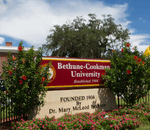 |
Rosen Foundation expanding scholarship program, partnering with Bethune-Cookman UniversityCarrying on the legacy of Harris Rosen and his commitment to education, today the Harris Rosen Foundation announced it is expanding its already-successful scholarship program and partnering with Bethu ...more
Reginald Culpepper • 297 Views • May 19th, 2026 |
 |
Sinners vs. Michael: Which Film Actually Won the Ultimate Culture Debate?While Antoine Fuqua’s Michael is dominating the box office with its electrifying, stadium-level concert recreations and a star-making, uncanny physical performance by Jaafar Jackson, critics and film ...more
TaQuan Ford • 233 Views • May 16th, 2026 |

Popular News



 |
North Carolina HBCU Unity DayShaw University - Elizabeth City State University - Johnson C. Smith University - Fayetteville State University - Livingstone College - North Carolina A&T State University - North Carolina Central Uni ...more
Reginald Culpepper • 109,467 Views • August 8th, 2016 |


