








A Brief History: The Rise of Historically Black Colleges and Universities

|
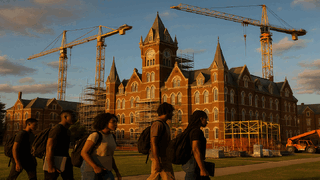
Posted By: S. Moore on February 28, 2024 Historically Black Colleges and Universities (HBCUs) are public and private institutions established before the Civil Rights Act of 1964 in the United States. Here's a brief history of the rise of HBCUs in the United States. Although HBCUs make up 3% of America’s academic institutions, the transformative schools play an integral role in bridging the opportunity gap within higher education. These institutions have and continue to produce some of the most influential trailblazers from minority ethnic groups, solidifying their importance in academia. Why HBCUs ExistBefore the abolishment of slavery in 1865, anti-literacy laws prevented enslaved and free Black people from obtaining an education. These laws existed because slave owners and anti-abolitionists feared that if enslaved and free people of color became literate, they would no longer be able to control them. Without that control, their economy, which was built on slave labor, would collapse. Although free people of color were allowed to attend white universities in states that abolished slavery, they still faced overt racism and discrimination by their white peers. Black students also tended not to fare well at white institutions because there were significant gaps in their knowledge and college readiness. The Growth of HBCUsSeeing a need and opportunity for reform, Quaker philanthropist Richard Humphreys founded the Institute for Colored Youth in Cheyney Pennsylvania in 1837. He wanted to create an institution for formerly enslaved African Americans to learn basic skills like reading, writing and math so they could become equipped for the world that they were entering as free people. The Institute eventually became Cheyney University of Pennsylvania, the first HBCU. Gradually, more universities were established with a large surge of new institutions coming into existence after the passing of the Second Morrill Act of 1890. The act required states that supported racial segregation in schools to create and fund public institutions for Black students. Schools that served Black communities faced many hurdles with funding and access to resources being a major barrier. This increase in funding led to more Black people attending college and thus a need for more schools. Even after segregation ended in 1964, predominantly Black Institutions (PBIs) opened with the intention of using education to further uplift Black people economically and socially. PBIs are now considered HBCUs, as the terms are interchangeable. Currently, 107 HBCUs are located throughout the United States. The Impact of HBCUs TodayWhile HBCUs are no longer the only path to higher education for people of African descent, due to the Civil Rights Act of 1964, Black students still attend them in increasing numbers. HBCUs remain a refuge for students to delve further into their cultural heritage and excel academically without fear of discrimination. Whether it’s the groundbreaking STEM and liberal arts programs, low-cost tuition, dynamic atmosphere, or large diversity of students and professors, students are looking to HBCUs for a quality education and reflective cultural experience. The institutions even attract students from other ethnic backgrounds. In 2018, non-Black students made up 24% of enrollment at HBCUs compared to 15% in 1976. The growing enrollment of ethnically, religiously, and culturally diverse students at HBCUs encourage the federal government to respect and invest in the institutions. Legislation continues to pass that strengthens educational resources, increases administrative capacity, and provides great financial assistance for students at these powerful think tanks. HBCUs are golden products of the African diaspora and symbols of the strength and resilience of Black people. Their rich culture and academic rigor have allowed them to persevere despite continued obstacles. As evidenced by their long list of notable alumni, such as Thurgood Marshall, Spike Lee, Toni Morrison and U.S. Vice President Kamala Harris, there’s no doubt that HBCUs will always be necessary and valuable members of the academic world. If you enjoyed this article, Join HBCU CONNECT today for similar content and opportunities via email! |
Comments
More From This Author
Latest News
 |
Rosen Foundation expanding scholarship program, partnering with Bethune-Cookman UniversityCarrying on the legacy of Harris Rosen and his commitment to education, today the Harris Rosen Foundation announced it is expanding its already-successful scholarship program and partnering with Bethu ...more
Reginald Culpepper • 281 Views • May 19th, 2026 |
 |
Sinners vs. Michael: Which Film Actually Won the Ultimate Culture Debate?While Antoine Fuqua’s Michael is dominating the box office with its electrifying, stadium-level concert recreations and a star-making, uncanny physical performance by Jaafar Jackson, critics and film ...more
TaQuan Ford • 222 Views • May 16th, 2026 |
 |
Healthcare Career Fair Aims to Connect Employers with Qualified Local Talent in Northern VirginiaHealthcare organizations across Northern Virginia will have an opportunity to connect directly with qualified job seekers this June during the upcoming Healthcare Career Fair in Prince William County. ...more
Reginald Culpepper • 407 Views • May 15th, 2026 |
Popular News


 |
North Carolina HBCU Unity DayShaw University - Elizabeth City State University - Johnson C. Smith University - Fayetteville State University - Livingstone College - North Carolina A&T State University - North Carolina Central Uni ...more
Reginald Culpepper • 109,433 Views • August 8th, 2016 |


