




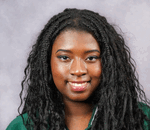

Hampton University's Wanda Sykes: Her Startling Ancestry Roots

|
Posted By: Reginald Culpepper on March 22, 2012 FEATURED Content Wanda Sykes' family history was professionally researched for a segment of Finding Your Roots With Henry Louis Gates Jr., a new series that will debut Sunday on PBS. While Gates, The Root's editor-in-chief and director of the W.E.B. Du Bois Institute for African and African American Research at Harvard, has interesting genealogical tidbits to share with all of his subjects, Sykes' report was especially revealing, according to the New York Times. "The bottom line is that Wanda Sykes has the longest continuously documented family tree of any African American we have ever researched," Gates said. He traced her roots to her paternal ninth great-grandmother, Elizabeth Banks, a free white woman, who was punished with "thirty-nine lashes, well laid" for "fornication & Bastardy with a negroe slave," according to a stark June 20, 1683, court document from York County, Va. He was referring to the dozens of genealogies his researchers have unearthed for his television roots franchise, which began in 2006 with the PBS series African-American Lives and includes three other genealogy-inspired shows. Thirty-nine lashes “well laid” on her bare back and an extension of her indentured servitude was Elizabeth Banks’s punishment for “fornication & Bastardy with a negroe slave,” according to a stark June 20, 1683, court document from York County, Va. Through the alchemy of celebrity and genealogy, that record and others led to the recent discovery that Banks, a free white woman despite her servitude, was the paternal ninth great-grandmother of Wanda Sykes, the ribald comedian and actress. More than an intriguing boldface-name connection, it is a rare find even in a genealogy-crazed era in which Internet sites like ancestry.com, with more than 14 million users, and the popular NBC program “Who Do You Think You Are?” play on that fascination. Because slavery meant that their black ancestors were considered property and not people, most African-Americans are able to trace their roots in this country only back to the first quarter of the 19th century. “This is an extraordinary case and the only such case that I know of in which it is possible to trace a black family rooted in freedom from the late 17th century to the present,” said the historian Ira Berlin, a professor at the University of Maryland known for his work on slavery and African-American history. Mary Banks, the biracial child born to Elizabeth Banks around 1683, inherited her mother’s free status, although she too was indentured. Mary appeared to have four children. There are many other unanswered questions, but the family grew, often as free people of color married or paired off with other free people of color. Ms. Sykes’s family history was professionally researched for a segment of “Finding Your Roots With Henry Louis Gates Jr.,” a new series that has its debut Sunday on PBS. “The bottom line is that Wanda Sykes has the longest continuously documented family tree of any African-American we have ever researched, ” said Mr. Gates, the director of the W. E. B. Du Bois Institute for African and African American Research at Harvard. He was referring to the dozens of genealogies his researchers have unearthed for his television roots franchise, which began in 2006 with the PBS series “African-American Lives” and includes three other genealogy-inspired shows. Mr. Gates said he also checked Ms. Sykes’s family tree with historians, including Mr. Berlin. Among the subjects whose pasts are summoned this season on “Finding Your Roots” are Barbara Walters (who learns her original family surname), Harry Connick Jr., Samuel L. Jackson, Margaret Cho, Kevin Bacon, Representative John Lewis of Georgia, Branford Marsalis, Robert Downey Jr. and Dr. Sanjay Gupta. The episode with Ms. Sykes is set for May. “I was so disappointed he didn’t get me any casino money out of this,” Ms. Sykes said in an interview. She added, referring to Mr. Gates by his nickname: “Come on Skip, tell me I’m a relative of Pocahontas. I would have retired.” Ms. Sykes, 48, is known for her salty stand-up act as well as comedic roles in film (“Monster in Law”) and on television (“The New Adventures of Old Christine,” “Curb Your Enthusiasm”). But after learning about those largely unknown relatives, she said, “It was very emotional,” adding that she thought about the hardships they endured. She was also crushed to discover that two of them owned slaves themselves. “It’s no princess story, not at all,” she said. Generations of Sykeses have remained in Virginia. Elizabeth Banks (born around 1665) probably arrived from Scotland. Ms. Sykes herself was born in Portsmouth, Va., and grew up in the Washington area, the child of Harry Ellsworth Sykes, an Army colonel, and the former Marion Louise Peoples, who worked at a bank. Ms. Sykes has fraternal twins with her wife, Alex Sykes, and said she eventually plans to share the new family tree with them. “I’m just grateful I do have a history, “Ms. Sykes said. “It’s bittersweet. I was not able to trace the other three grandparents, and that’s huge. “It shows that we’re still paying for the history of this country, basically. It’s just incredible to go back and see that you did not matter.” Africans arrived in the New World in Jamestown in 1619. But because most African-Americans were listed only as property on official documents, their descendants lack the marriage records, wills, property and other information to find them. Free blacks, who left a paper trail, can be traced more easily. The first year that all African-Americans were listed by name in the federal census is 1870. The initial evidence of Ms. Sykes’s free ancestors involved the 1853 marriage recorded for her third great-grandparents, with the words “free Negroes” right after their names. Those papers — entries from the Register of Free Negroes — also helped lead researchers all the way back to Elizabeth Banks. Johni Cerny, who is the chief genealogist for Mr. Gates’s television programs, noted that many African-Americans with white ancestry could trace their heritage beyond the 1600s to European ancestors. She said 85 percent of African-Americans have some European ancestry. “The unique thing about Wanda is that she descends from 10 generations of free Virginia mulattos, which is more rare than descendants of mixed-race African-Americans who descend from English royalty,” Ms. Cerny wrote in an e-mail message. More than 1,000 mixed-race children were born to white women in colonial Virginia and Maryland, but their existence has been erased from oral and written history, said Paul Heinegg, a respected lay genealogist and historian. Mr. Heinegg’s Web site, freeafricanamericans.com, features books and documents like tax lists that provide information about those families. The tale of Elizabeth Banks and the nameless black man with whom she had at least one child (records indicate the possibility of a second half-black daughter, Anne, whose father is unknown) pushes us to imagine the lives of the first Africans in the New World beyond popular images of plantation life, Mr. Berlin said. In the Virginia colony of the mid- and early-1600s it was not unusual for blacks and white indentured servants to come together in the shared misery of bondage, he said, before the development of a distinct slave society and hardened racial attitudes. It also highlights a black family that defied the odds and thrived. “What kind of world does Elizabeth live in that not only does she have this relationship with a black guy but she builds upon this to ensure her children are free and they continue to be free?” Mr. Berlin said. All the way to Wanda Sykes. SOURCE: NYTIMES.COM http://www.nytimes.com/2012/03/20/arts/tel... If you enjoyed this article, Join HBCU CONNECT today for similar content and opportunities via email! |
 |
Reginald Culpepper
President, Fulfillment and Web Services, HBCUCONNECT Clark Atlanta University class of 1998 Member Since September 2000 |
Comments
 |
["What kind of world does Elizabeth live in that not only does she have this relationship with a black guy but she builds upon this to ensure her children are free and they continue to be free?” Mr. Berlin said. All the way to Wanda Sykes. ] That's what I call a woman with a vision of posterity for the future generations... and also what I call a perfect example of what it is to be a Free Woman!!! Hello somebody. Friday, March 23rd 2012 at 1:14PM |
|
Preach sis Jen! lol
Friday, March 23rd 2012 at 2:51PM |
|
((Lol)) Amen! Friday, March 23rd 2012 at 7:51PM |
 |
Good stuff! www.youtube.com/dandonthefly
Thursday, May 3rd 2012 at 11:50AM |
|
Henry hasn't talked to many people apparently from VA. I am descended from the first female Davenport indentured servant in Colonial Virginia. We can trace it. We also thought we were related to Wanda when she was at Hampton and was in the same class with my brother, Benton. This was on her mother's side which she stated she didn't know much about according to a newspaper article about this program. I did not see the tv show featuring her. In the earliest days of Virginia, Blacks and whites intermarried. The white women who had children out of wedlock later were brought before the church and punished for bastardy, not in the earliest days. This is what happened later in my family tree. Also, a child could be born to a mixed race couple and later become whatever race the parents were 3 or 4 generations away. It was up to the clerk who registered the child. Blacks , whites and Indians intermarried in Virginia until the 20's when there was a big crackdown. There were no more marriages or common law unions after the early 20's among mixed race individuals, except for whites and Indians which was permitted by the VA assembly.
Monday, August 13th 2012 at 5:19PM |
More From This Author
| Alpha Kappa Alpha Sorority, Incorporated Hosts 94th South Central Regional Conference in Shreveport, Louisiana |
| Register Now For This Upcoming Diagnostic Imaging Virtual Info Session and Q&A with Providence on April 16th |
Latest News
 |
Influence Without ForceDear HBCU,
I hope you are well. I am reaching out to invite your institution to sponsor and champion a historic movement: the 1 Billion Unit Challenge, inspired by my book Influence Without Force. ...more
Valerie Ellis • 96 Views • April 19th, 2026 |
 |
HBCULift Launches to Strengthen and Sustain HBCUs Through Strategic Innovation and Alumni Engagement |

Popular News



 |
North Carolina HBCU Unity DayShaw University - Elizabeth City State University - Johnson C. Smith University - Fayetteville State University - Livingstone College - North Carolina A&T State University - North Carolina Central Uni ...more
Reginald Culpepper • 107,267 Views • August 8th, 2016 |


